Table of Contents
SBRT (Stereotactic Body Radiation Therapy): Precision Radiation in Fewer Sessions

By Dr. Gajendra Kumar Himanshu


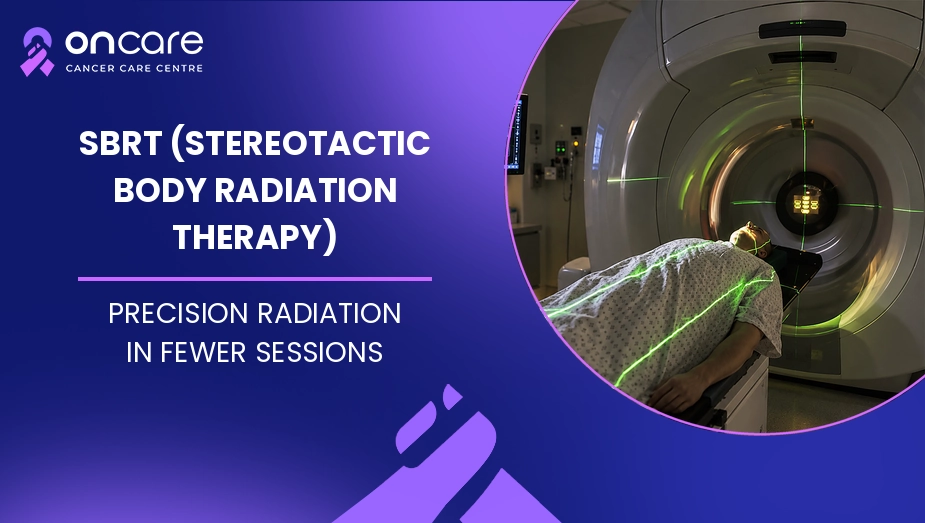
SBRT (Stereotactic Body Radiation Therapy) is an advanced form of external radiation therapy that delivers a high dose of radiation very precisely to a small, well-defined tumor while trying to protect nearby healthy tissue. Unlike conventional radiation therapy, which may require many treatment sessions, SBRT can often be completed in just a few sessions, commonly up to five depending on the cancer and treatment plan.
If you or your family member has been advised to consider SBRT, it is natural to have questions about how it works, who can receive it, how many sessions are needed, and whether it has side effects. In this blog, we will explain SBRT in simple words, including its benefits, treatment process, possible side effects, and how doctors decide whether it is suitable for a patient.
What Is SBRT?
SBRT is a type of external radiation therapy that uses special machines and detailed imaging to target a tumor with high accuracy. The radiation is focused on the tumor from different directions so that the main dose reaches the cancer while limiting radiation to nearby normal tissues.
SBRT is also called stereotactic ablative body radiation therapy (SABR). It is different from stereotactic radiosurgery, which is mainly used for tumors in the brain. SBRT is generally used for tumors in other parts of the body, such as the lung, liver, prostate, and selected other areas.
If you want to understand the basics first, you can read our page on radiation therapy to learn how radiation treatment works and how it is used in cancer care.
How Does SBRT Work?
SBRT starts with careful treatment planning. Your radiation team uses scans such as CT or MRI, depending on the cancer and treatment area, to understand the exact size and position of the tumor.
The patient is positioned carefully during each treatment. Special equipment helps keep the body in the correct position, while the radiation team uses the treatment plan to direct radiation toward the tumor.
Because the radiation dose is higher in each session, fewer sessions may be needed. The National Cancer Institute notes that SBRT is often given in up to five doses, usually once per day, although the exact schedule depends on the patient's condition.
Why Is Precision Important?
Many tumors are close to important organs and healthy tissues. SBRT is designed to deliver radiation very accurately, which can help reduce unnecessary radiation exposure to nearby tissues.
However, precision does not mean that side effects are impossible. The risk depends on the location of the tumor, the dose, nearby organs, and the patient's overall health.
Who May Be a Candidate for SBRT?
SBRT is not suitable for every cancer patient. Doctors usually consider factors such as:
- The type and stage of cancer
- Tumor size and exact location
- Whether the tumor is clearly visible on scans
- The distance between the tumor and nearby sensitive organs
- Previous radiation treatment
- Overall health and other medical conditions
SBRT may be considered for some small, well-defined tumors and for certain patients who cannot have surgery because of their age, health, or tumor location.
Your radiation oncologist will review your scans, biopsy results, previous treatments, and overall health before recommending SBRT.
For patients who are still understanding their diagnosis, our blog on types of radiation therapy explains how different radiation techniques are used in cancer treatment.
SBRT vs Conventional Radiation Therapy
The biggest difference is usually the number of treatment sessions and the amount of radiation given during each session. Conventional radiation therapy often uses smaller doses over a longer period, while SBRT uses higher doses delivered in fewer sessions.
Feature | SBRT | Conventional Radiation Therapy |
|---|---|---|
Radiation dose per session | Higher | Usually lower |
Number of sessions | Often fewer | Usually more |
Treatment time | Shorter overall | Longer overall |
Targeting | Highly precise | Can also be highly precise, depending on technique |
Best suited for | Selected tumors and patients | Many different cancer situations |
Planning | Very detailed | Detailed planning is also required |
Fewer sessions can be convenient for patients because they may spend less time travelling to the treatment centre. However, fewer sessions do not automatically mean SBRT is better for everyone. The right treatment depends on the cancer and the patient's individual situation.
What Happens During SBRT Treatment?
Before treatment starts, the radiation team creates a detailed treatment plan. You may have imaging and a planning appointment to determine your exact treatment position.
During treatment, you will lie in a specific position while the radiation machine delivers the planned radiation. The treatment itself does not involve cutting or surgery.
The planning stage is very important because even small changes in the tumor's position or the patient's body position can affect treatment accuracy. You can also learn more about this process in our blog on your first radiotherapy planning session.
What Are the Side Effects of SBRT?
Side effects can vary depending on the part of the body being treated. Some people have few side effects, while others may experience symptoms related to the treatment area.
Possible side effects may include:
- Tiredness
- Skin changes in the treated area
- Pain or swelling
- Changes in bowel or bladder habits when those areas are treated
- Cough or breathing-related symptoms when the lung area is treated
The exact risks should be discussed with your radiation oncologist because SBRT delivers a high radiation dose to a focused area.
What Are the Benefits of SBRT?
SBRT can offer several benefits for carefully selected patients. The main advantage is that it can deliver a high radiation dose to a small tumor in fewer treatment sessions.
Some possible benefits include:
- Fewer hospital visits
- Shorter overall treatment time
- Precise targeting of the tumor
- A non-surgical treatment option for some patients
- Useful for certain tumors that are difficult or unsafe to remove with surgery
Research has shown that SBRT can be an effective treatment option for selected cancers. For example, an NCI-supported study found that five-session SBRT was comparable to longer radiation schedules for certain intermediate-risk prostate cancers.
Is SBRT the Same as Surgery?
No, SBRT is a form of radiation therapy and does not involve physically removing the tumor. It uses focused radiation to damage the DNA of cancer cells so they can no longer grow and divide.
For some patients, SBRT may be used instead of surgery, while in other cases it may be combined with surgery, chemotherapy, immunotherapy, or other treatments. The decision depends on the type and stage of cancer.
Consult Today
Choosing the right radiation treatment requires careful evaluation of the tumor, scans, previous treatments, and overall health. SBRT can be a useful option for selected patients, but it is not suitable for every cancer or every tumor.
At Oncare Cancer Hospital, the cancer care team can review your diagnosis and treatment reports and help you understand whether SBRT or another radiation approach may be appropriate for you. You can also explore our radiation therapy services to learn more about available cancer treatment options.
Disclaimer
This information is for educational purposes only and does not constitute medical advice, diagnosis, or treatment. Whether SBRT is suitable depends on the cancer type, tumor location, and each patient's overall health, and requires individual evaluation. Always discuss radiation treatment decisions with a certified radiation oncologist or cancer healthcare provider.





Frequently Asked Questions
SBRT is commonly given in a small number of sessions, often up to five. The exact number depends on the cancer type, tumor location, size, and treatment plan.
The radiation treatment itself is generally not painful. However, some patients may develop side effects depending on the area being treated.
Not always. SBRT is designed for specific situations and is not suitable for every patient. Your radiation oncologist will choose the most appropriate technique based on your cancer.
SBRT can provide effective local treatment for selected tumors, but whether it can control or cure cancer depends on the cancer type, stage, tumor characteristics, and other factors.
Written and Verified by:
Dr. Gajendra Kumar Himanshu Exp: 10 Yr
Medical Officer
Book an Appointment
Related Blogs

Immunohistochemistry (IHC) Testing: How Labs Identify Your Exact Cancer Type
Learn what IHC testing is, why it is done, common cancer markers, how results are interpreted, and how they can guide treatment with Oncare Cancer Hospital.
Frozen Section Biopsy: How Doctors Take Decisions During Surgery
Learn what a frozen section biopsy is, how it is done during surgery, and its uses, results, benefits, and limitations with guidance from Oncare Cancer Hospital.
Pleural Tap (Thoracentesis): Draining Fluid Around the Lungs in Cancer
Learn what a pleural tap is, why it is done in cancer, how it helps with breathing, its risks, and what happens if fluid returns. Oncare Cancer Hospital's guidance.