Table of Contents
Breast MRI: When Is It Needed Instead of or Along With a Mammogram?

By Dr. Gajendra Kumar Himanshu


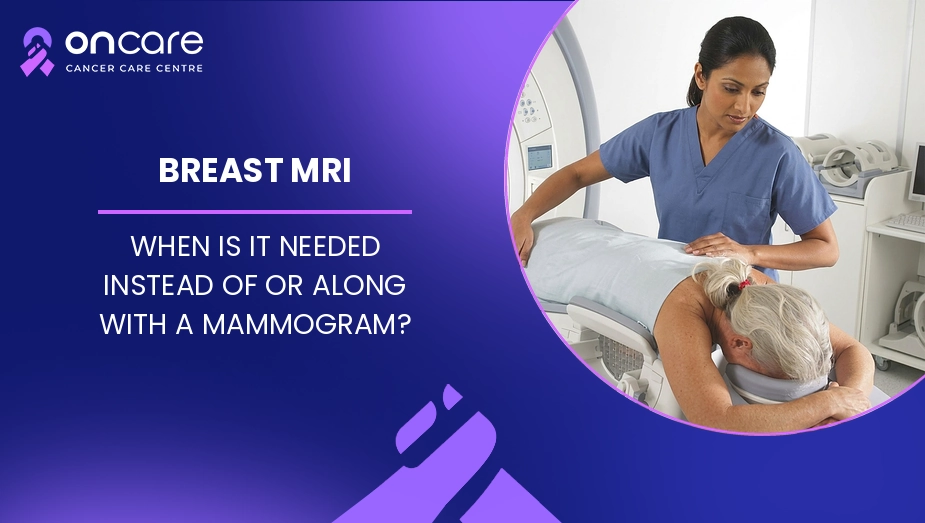
A breast MRI is usually not a replacement for a mammogram. It is a more detailed imaging test that may be recommended along with a mammogram for women who have a high risk of breast cancer. Breast MRI can also be used when a doctor needs more information about a breast problem, a suspicious finding, or an already diagnosed breast cancer. For women at average risk, routine MRI screening is generally not recommended because it can find areas that are not cancer and may lead to unnecessary tests.
In this blog, we will explain what a breast MRI is, how it is different from a mammogram, when doctors may recommend both tests, and when MRI may be used for diagnosis or treatment planning. We will also look at breast density, family history, genetic risk and other factors that can affect the decision.
What Is a Breast MRI?
A breast MRI (Magnetic Resonance Imaging) uses strong magnets and radio waves to create detailed pictures of the breast. Unlike a mammogram, it does not use X-rays. In most breast MRI examinations, a contrast dye is given through a vein so that abnormal areas can be seen more clearly.
Breast MRI can show details that may not be easy to see on a mammogram. However, seeing more detail does not always mean finding cancer. MRI can also detect harmless areas, which may lead to extra imaging or a biopsy.
If you want to learn more about the different tests used to find breast cancer, read our blog on breast cancer screening tests.
Mammogram vs Breast MRI: What Is the Difference?
A mammogram and breast MRI use different technologies and are useful for different reasons. A mammogram uses low-dose X-rays to create images of the breast and remains an important breast cancer screening test. A breast MRI uses magnets, radio waves and usually contrast dye to create detailed images of breast tissue. Here is a simple comparison:
Feature | Mammogram | Breast MRI |
|---|---|---|
Technology | Low-dose X-rays | Strong magnets and radio waves |
Radiation | Uses a small amount of radiation | No radiation |
Contrast dye | Usually not needed | Usually needed |
Main use | Routine breast cancer screening | High-risk screening and further evaluation |
Image detail | Good for many breast changes and calcifications | Very detailed view of soft tissue |
For average-risk screening | Commonly used | Usually not recommended routinely |
For high-risk women | Recommended | Often used along with mammography |
Time and process | Usually quick | Takes longer and requires lying inside an MRI scanner |
The two tests are not simply alternatives. In many high-risk situations, MRI is used in addition to, rather than instead of, mammography.
When Is Breast MRI Needed Along With a Mammogram?
Doctors may recommend yearly breast MRI together with a mammogram for women who have a high risk of breast cancer. This may include women with a lifetime breast cancer risk of about 20% to 25% or greater, based mainly on family history and individual risk assessment.
Breast MRI may be considered for women who:
- Have a known BRCA1 or BRCA2 gene change
- Have a close family member with a BRCA mutation but have not been tested themselves
- Have a very high estimated lifetime risk of breast cancer
- Received radiation therapy to the chest at a young age
- Have certain inherited conditions linked with a higher breast cancer risk, such as Li-Fraumeni syndrome or Cowden syndrome
The exact screening plan should be based on your personal risk and discussed with your doctor.
Is Breast MRI Needed for Dense Breasts?
Dense breasts do not automatically mean that you need a breast MRI.
Dense breast tissue contains more glandular and fibrous tissue and less fatty tissue. On a mammogram, dense tissue can make some cancers harder to see because both dense tissue and many breast abnormalities can appear white.
Some women with dense breasts may benefit from additional imaging. Depending on their overall risk, doctors may consider 3D mammography, ultrasound or MRI. The decision should not be based on breast density alone.
If you have recently noticed a lump, nipple change or another unusual breast change, you can read our blog on breast cancer symptoms for more information.
When Can Breast MRI Be Used Instead of a Mammogram?
For routine breast cancer screening, MRI is generally not used instead of a mammogram. Even though MRI can find some cancers that mammography may miss, it can also miss certain cancers that a mammogram can detect. This is one reason high-risk women who receive MRI are generally advised to continue mammography as well.
There may be situations where a doctor cannot perform a mammogram or needs another imaging approach, but this depends on the person’s medical situation. Your doctor may recommend MRI, ultrasound or another test based on your symptoms and risk factors.
When Is Breast MRI Used for Diagnosis?
Breast MRI can also be used when a doctor needs more information about a breast problem.
For example, it may be recommended when:
- A mammogram or ultrasound shows a suspicious or unclear area
- A doctor needs to understand the size or location of a known breast cancer
- There is a need to check for additional tumours in the breast or the opposite breast
- A doctor needs to assess certain breast implant problems
Mammogram and ultrasound are often performed before MRI when investigating a breast concern, although the exact order depends on the situation.
For a broader look at how doctors investigate a breast problem, read our blog on breast cancer diagnosis.
What Are the Limitations of Breast MRI?
Breast MRI gives highly detailed images, but it is not a perfect test.
One important limitation is that MRI can show areas that look suspicious but are actually harmless. This is called a false-positive result. It can lead to additional scans, follow-up appointments or biopsies.
MRI also usually requires contrast dye through an IV. Some people may not be suitable for MRI or contrast because of certain medical conditions, implants or other factors. Your healthcare team will review your medical history before the test.
Another consideration is cost and availability. Breast MRI can be more expensive than mammography and may require insurance approval in some situations.
Do You Need a Mammogram, MRI, or Both?
The answer depends mainly on your breast cancer risk and the reason for the test.
For women at average risk, mammography remains an important screening tool. For women at high risk, doctors may recommend both a mammogram and yearly breast MRI. MRI may also be used when a doctor needs a closer look at a breast abnormality or wants more information after a cancer diagnosis.
A personal risk assessment can help determine whether additional screening is useful. Family history, genetic changes, previous radiation treatment and previous breast conditions can all affect the screening plan.
If you want to learn more about breast cancer screening, then you can visit the official website of the National Cancer Institute.
Consult Today
If you are unsure whether you need a mammogram, breast MRI, ultrasound or more than one breast imaging test, it is best to discuss your situation with a qualified cancer specialist.
At Oncare Cancer Hospital, the medical team can review your symptoms, family history, previous reports and other risk factors to help determine which evaluation may be appropriate for you. Early medical advice can also help avoid unnecessary tests while making sure important breast changes are properly investigated.
Disclaimer
This information is for educational purposes only and does not constitute medical advice, diagnosis, or treatment. Always discuss decisions about breast imaging, screening tests, or any cancer treatment with a certified cancer healthcare provider.





Frequently Asked Questions
Not necessarily. They are different tests. MRI can find some abnormalities that mammography may miss, while mammography can detect some cancers that MRI may miss. High-risk women may need both.
Usually no. When MRI is recommended for high-risk screening, it is generally used along with a mammogram rather than replacing it.
Not always. Dense breasts can make mammograms harder to interpret, but the need for MRI depends on your overall breast cancer risk and other factors.
No, breast MRI uses strong magnetic fields and radio waves rather than X-rays. Contrast dye is usually given to make breast tissue easier to evaluate.
Written and Verified by:
Dr. Gajendra Kumar Himanshu Exp: 10 Yr
Medical Officer
Book an Appointment
Related Blogs
3D Mammography (Tomosynthesis) vs 2D Mammogram: Which One Do You Need?
Learn how 2D and 3D mammograms differ, what to expect, and which test may suit you based on breast density and risk. Get expert guidance from Oncare Hospital.

Esophagectomy: Food Pipe Cancer Surgery and How to Eat After
Learn about esophagectomy for food pipe cancer, including the surgery, recovery, dumping syndrome, nutrition, and follow-up at Oncare Cancer Hospital.

Hairy Cell Leukaemia: Symptoms, Diagnosis and Treatment of a Rare Blood Cancer
Learn about hairy cell leukaemia, its symptoms, causes, diagnosis, BRAF testing, treatment options, watchful waiting and follow-up care at Oncare Cancer Hospital.