Table of Contents
Voice Rehabilitation After Laryngectomy: Speaking Again

By Dr. Gajendra Kumar Himanshu


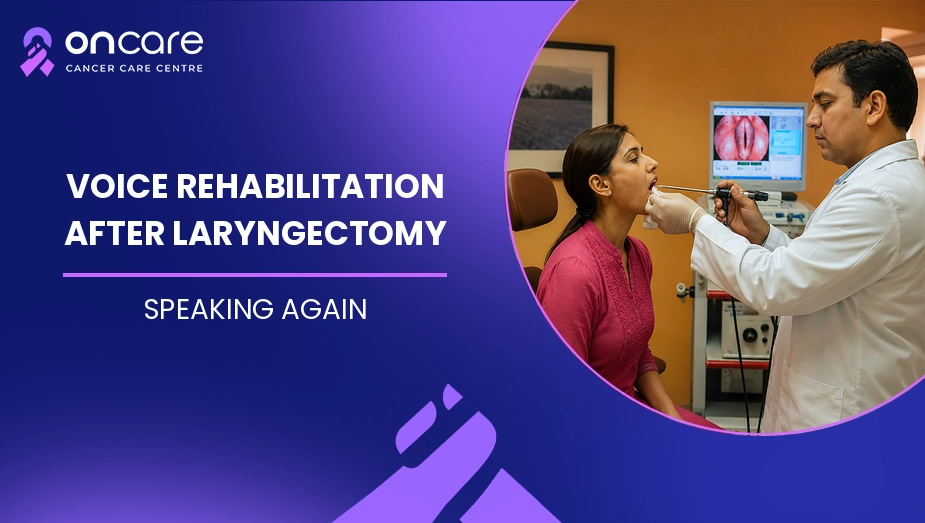
Voice rehabilitation after a laryngectomy helps patients regain their voice after the removal of the voice box (larynx). However, nothing can truly replace the natural voice; most patients are able to speak again using a voice prosthesis, esophageal speech, or an electrolarynx. Early rehabilitation with a speech-language pathologist improves communication ability, self-confidence, and overall quality of life.
In this blog, we'll discuss voice rehabilitation after laryngectomy, why speech changes after surgery, the numerous methods patients can use to recover their ability to speak, the rehabilitation process, what to expect in terms of recovery, and practical advice on how to adjust to daily life with confidence.
Why Voice Rehabilitation Is Important?
Laryngectomy is a life-saving procedure that may be suggested for advanced laryngeal cancer or other serious disorders affecting the voice box. The procedure takes the sickness out, but it alters a person's breathing and speech.
Losing the natural voice can impact mental health, relationships, employment, and social contact. Many patients are scared they'll never be able to speak normally again. Fortunately, there are several effective solutions available today for voice rehabilitation so that people can talk clearly and get back to their normal activities. Professional guidance and regular practice help many regain their confidence to communicate.
Why Does Speech Change After a Laryngectomy?
Inside the larynx are the vocal cords, which create sound as air passes over them. Total laryngectomy means removal of the entire larynx, and the patient's respiration is diverted through a permanent opening in the neck called a stoma.
Because the vocal cords are gone, the air from the lungs can not make a genuine voice. Voice therapy gives patients other ways to make sound and communicate successfully.
Voice Rehabilitation Alternatives
There's no single best way for everyone. The proper option relies on the patient's health, body structure, lifestyle, and personal preferences.
Tracheoesophageal Prosthesis (TEP)
A tracheoesophageal puncture (TEP) with a voice prosthesis is one of the most natural-sounding choices for speaking following total laryngectomy.
There's a small one-way valve between the trachea and the esophagus. When the stoma is covered, or a hands-free valve is utilized, air travels through the prosthesis and produces sound, which is molded into speech by the mouth and tongue.
Many patients find that this strategy results in fluent speaking with relatively little training.
Esophageal Speech
You do not need a gadget for esophageal speaking. Instead, patients learn to hold little amounts of air in the esophagus and force it out to make sound.
This technique doesn't require a prosthesis or batteries, which is why some people like it. But it does take time and constant practice.
Electric larynx
An electrolarynx is a hand-held electrical instrument that produces vibrations. Applied to the neck or cheek, these vibrations are turned into intelligible speech by movements of the lips and tongue.
Often, it is used immediately after surgery or if other techniques are not appropriate.
Voice rehabilitation entails what?
A speech-language pathologist provides a personalized rehabilitation strategy for voice recovery.
The rehabilitation process can include:
- Learning how to operate the selected speech method
- Breathing and speaking coordination exercises
- Training in stoma care and cleanliness
- Voice prosthesis maintenance if applicable
- Communication in daily life
- Emotional support and confidence development
Having treatment sessions is just as crucial as practicing regularly at home. Improvement is frequently a slow process, taking weeks or months.
Challenges During the Recovery
Learning to speak in a new way is emotionally and physically difficult. In the initial phase of therapy, some patients may be frustrated.
Common challenges are:
- Learning new speaking styles
- Care of the stoma and voice prosthetic
- Articulation in loud surroundings
- Working on temporary tiredness
- Less confident in social settings
Most of these challenges improve with experience, continued therapy, and support from health care professionals and family.
Tips for successful voice restoration
Patients often do better when they are an active part of their recovery.
Some helpful strategies are:
- Attend all speech therapy appointments.
- Practice every day like your therapist told you to.
- Take care of your stoma and keep it clean.
- If you have any concerns with your prosthesis, inform your care team immediately.
- Be patient, enjoy tiny wins.
- If there are any, get involved with support groups.
With steady effort, communication can become easier, and quality of life can get better with time.
Laryngectomy Life
Many people return to work, travel, enjoy hobbies, and engage in social activities after finishing voice therapy. Your speech may not sound exactly the same as it did before surgery, but most patients are able to communicate well.
Recovery is not simply learning to talk again. It's also about restoring confidence, keeping independence, and making successful adaptations to daily living.
If you want to read more about laryngeal cancer treatment, then you can visit the National Cancer Institute.
Consult Today
Voice rehabilitation is an important part of restoring communication to patients after removal of the voice box (laryngectomy). Most people can learn to talk again using a voice prosthesis, esophageal speech, or an electrolarynx with adequate rehabilitation and continuous practice. Working with a speech-language pathologist can help patients discover what works best for their particular requirements.
If you or a loved one are planning for or recuperating from a laryngectomy, the interdisciplinary team at Oncare Cancer Hospital can help guide you through therapy and voice rehabilitation. Early support from skilled oncologists and speech-language specialists can help you get back your communication and improve the quality of your life.
Disclaimer
This text is for educational purposes only and is not a substitute for professional medical advice, diagnosis, or treatment. Always visit your oncologist and speech-language pathologist for specific laryngectomy recovery and voice rehabilitation advice.





Frequently Asked Questions
It is not possible to restore a natural voice following total laryngectomy, but most patients can be trained to speak effectively with a vocal prosthesis, esophageal speech, or an electrolarynx.
Recovery time is different for each person. Some people are able to communicate within weeks; others may require several months of frequent speech treatment and practice.
There is no single best choice. What works best for you will depend on your health, your lifestyle, and the advice of your health care team.
Yes. Speech-language therapy is an important part of rehabilitation that teaches new speaking techniques, improves communication, and builds confidence in patients.
Written and Verified by:
Dr. Gajendra Kumar Himanshu Exp: 10 Yr
Medical Officer
Book an Appointment
Related Blogs

Generic vs Branded Cancer Drugs: Are They Equally Effective?
Compare generic vs branded cancer medicines, their safety, effectiveness, approval process, and costs. Get expert guidance at Oncare Cancer Hospital.

Circulating Tumour DNA (ctDNA): How Blood Tests Track Cancer
Learn how ctDNA liquid biopsy helps monitor cancer treatment, detect MRD, identify recurrence, guide targeted therapy, and support personalized cancer care.

Cancer and Blood Clots (DVT and Pulmonary Embolism): Risks and Prevention
Learn how cancer increases blood clot risk, DVT and PE symptoms, diagnosis, treatment, prevention tips, and when to seek urgent medical care.

Drugs Used in Mouth Cancer Treatment: Chemo and Targeted Options
How chemotherapy and targeted therapy are used in mouth cancer treatment, which drugs are commonly given, the side effects to expect, and how doctors decide which approach suits a patient.