Table of Contents
IMRT and IGRT: How Modern Radiotherapy Spares Healthy Tissue

By Dr. Gajendra Kumar Himanshu


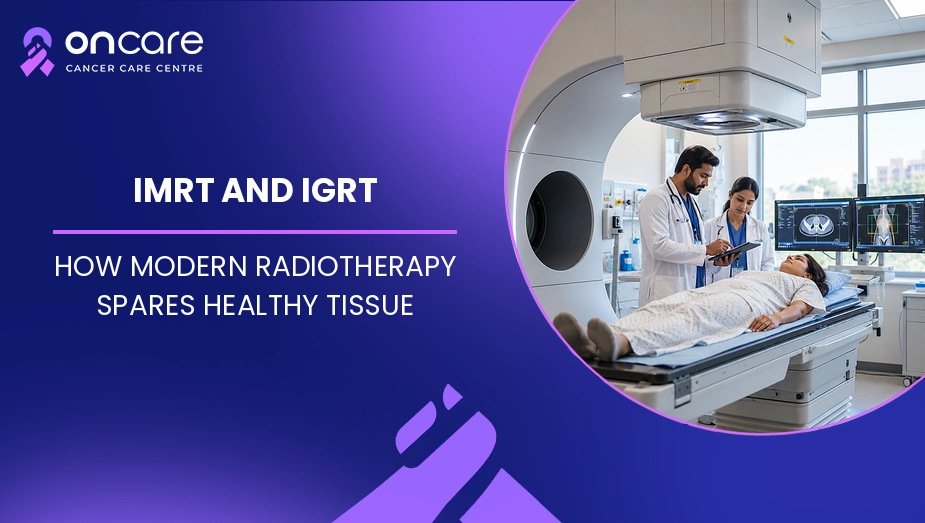
IMRT and IGRT are modern radiation therapy techniques that help doctors deliver radiation more precisely to a cancerous tumour while reducing unnecessary radiation exposure to nearby healthy tissues. IMRT adjusts the strength of radiation beams from different directions to better match the tumour. At the same time, IGRT uses imaging before or during treatment to confirm the tumour’s position and target radiation more precisely.
Radiation therapy is used to treat many types of cancer, but radiation can also affect healthy cells close to a tumour. Modern techniques such as IMRT and IGRT help radiation teams plan and deliver treatment more carefully.
In this blog, we will explain what IMRT and IGRT mean, how they work, how they differ, their benefits, possible side effects, and what patients can expect during treatment.
What Is IMRT?
IMRT stands for Intensity-Modulated Radiation Therapy. It is an advanced form of external beam radiation therapy. During IMRT, radiation beams are delivered from different directions, and the strength of these beams can be changed in different areas. This allows the radiation dose to be shaped more closely around the tumour.
The main aim is to give enough radiation to the cancer while limiting the dose received by nearby healthy organs. This can be especially useful when a tumour is close to important structures such as the brain, spinal cord, eyes, salivary glands, bowel, or bladder.
You can learn more about the types of radiation therapy to understand where IMRT fits into modern cancer treatment.
What Is IGRT?
IGRT stands for Image-Guided Radiation Therapy. It uses medical imaging to check the location of the tumour and the patient’s position before or during radiation treatment. Depending on the treatment plan, imaging may include CT, MRI, ultrasound, or X-rays.
The body does not always stay in the same position from one treatment session to another. Some tumours can also move because of breathing, digestion, or other normal body movements. IGRT allows the treatment team to compare images with the original treatment plan and make adjustments when needed.
In simple words, IMRT helps shape and control the radiation dose, while IGRT helps make sure the radiation is aimed at the right place.
How Do IMRT and IGRT Work Together?
IMRT and IGRT are not competing treatments. They can be used together.
First, the radiation team creates a detailed treatment plan using scans such as CT or MRI. The tumour and nearby organs are identified. Computer software then helps calculate how radiation should be delivered.
With IMRT, the strength of individual radiation beams can be adjusted. With IGRT, images can be taken before or during treatment to check positioning and make corrections when necessary.
This combination can be particularly helpful when the tumour is close to sensitive organs or when its position can change between treatment sessions.
How Do IMRT and IGRT Help Protect Healthy Tissue?
Radiation cannot always avoid healthy tissue completely. However, modern planning aims to reduce unnecessary exposure as much as possible.
IMRT can change the intensity of different radiation beams so that higher doses can be directed toward the tumour while lower doses reach nearby sensitive structures.
IGRT adds another level of accuracy by checking the patient’s position and treatment area using images. If there is a small difference from the planned position, the treatment team can make adjustments before delivering the radiation.
This does not mean that side effects are completely avoided. The risk still depends on the cancer location, radiation dose, treatment area, and individual health.
IMRT vs IGRT: What Is the Difference?
The table below compares the two techniques side by side.
Feature | IMRT | IGRT |
|---|---|---|
Full name | Intensity-Modulated Radiation Therapy | Image-Guided Radiation Therapy |
Main purpose | Controls the strength and shape of radiation beams | Checks the tumour and body position |
Uses imaging | Mainly for treatment planning | Before or during treatment |
Main benefit | Helps limit radiation to nearby healthy tissue | Helps improve treatment accuracy |
Can be used with the other? | Yes | Yes |
Useful when | Tumour is close to sensitive organs | Tumour position may change between sessions |
Both techniques can be part of the same treatment plan. The radiation oncologist decides whether they are appropriate based on the cancer and treatment goals.
Which Cancers Can Be Treated With IMRT and IGRT?
IMRT and IGRT can be used for many cancers when external radiation therapy is appropriate. The choice depends on the tumour’s location, size, shape, stage, and its distance from important organs.
They may be useful for cancers involving areas such as:
- Head and neck
- Brain
- Prostate
- Lung
- Breast
- Abdomen and pelvis
For example, in head and neck cancers, radiation may need to be delivered close to structures such as the salivary glands and spinal cord. In prostate cancer, the prostate and nearby organs can shift slightly, making image guidance useful in selected cases.
The treatment team decides the technique based on each patient’s individual anatomy rather than using the same method for everyone.
What Happens During IMRT or IGRT Treatment?
Before treatment starts, you usually have a planning or simulation session. A CT scan is commonly used to create images of the treatment area. The team may also use MRI or other scans when needed. Special supports, masks, or positioning devices may be made to help you stay in the same position during treatment.
During each treatment session, you lie on a treatment table. The radiation machine moves around you and delivers radiation from planned directions. With IGRT, images may be taken before or during treatment to confirm your position.
External radiation treatment is usually painless, and most patients do not feel the radiation while it is being delivered.
Are There Side Effects?
IMRT and IGRT are designed to reduce unnecessary radiation to healthy tissue, but they cannot remove all side effects. Radiation can still affect healthy cells within or close to the treatment area.
Side effects depend on the part of the body being treated. Some patients may experience tiredness, skin changes, or other symptoms related to the treatment area.
For example, radiation to the head and neck may cause mouth or throat problems, while radiation to the abdomen or pelvis can cause digestive or urinary symptoms. Your radiation oncologist will explain the possible effects before treatment.
Are IMRT and IGRT Better for Every Patient?
Not necessarily. Modern radiation techniques are selected according to the cancer and the patient’s individual needs. Sometimes conventional radiation techniques are appropriate, while in other situations IMRT, IGRT, or another advanced method may offer better dose control.
The goal is not simply to use the newest technology. The goal is to choose a treatment that can safely deliver the required radiation dose while protecting normal organs as much as reasonably possible. Radiation planning considers the cancer stage and type, treatment goals, tumour location, and overall health.
If you want to read more about IMRT and IGRT, you can visit the National Library of Medicine.
Consult Today
IMRT and IGRT have made radiation therapy more precise by combining detailed treatment planning, controlled radiation beams, and image guidance. IMRT focuses on how the radiation dose is delivered, while IGRT focuses on where the radiation is delivered. When appropriate, using these techniques together can help limit radiation exposure to nearby healthy tissues.
At Oncare Cancer Hospital, radiation specialists can review your cancer type, stage, scans, and treatment goals to decide whether advanced radiation techniques such as IMRT or IGRT may be suitable for you. The treatment plan is tailored to the tumour and the surrounding healthy organs.
If radiation therapy has been recommended, discuss the available techniques with your radiation oncologist and ask how the treatment will protect nearby healthy tissues.
Disclaimer
This information is for educational purposes only and does not constitute medical advice, diagnosis, or treatment. Always discuss decisions about radiation therapy techniques or any cancer treatment with a certified cancer healthcare provider.





Frequently Asked Questions
IMRT controls the intensity and shape of radiation beams, while IGRT uses imaging to improve the accuracy of radiation delivery.
No, IMRT can reduce radiation exposure to nearby healthy tissue, but some healthy tissue may still receive radiation.
No, the imaging and external radiation treatment are generally painless. You usually need to remain still during treatment.
Yes, they can be combined when appropriate to improve radiation dose control and treatment accuracy.
Written and Verified by:
Dr. Gajendra Kumar Himanshu Exp: 10 Yr
Medical Officer
Book an Appointment
Related Blogs
Myelofibrosis: A Bone Marrow Disorder That Thickens With Scar Tissue
Learn about myelofibrosis, its causes, symptoms, diagnosis, bone marrow fibrosis, treatment options, and stem cell transplant at Oncare Cancer Hospital.
Ampullary Cancer: A Rare Tumour Near the Pancreas Explained
Learn about ampullary cancer, its symptoms, causes, diagnosis, Whipple surgery, treatment options, and recovery, with expert cancer care at Oncare Cancer Hospital.
Sinonasal Cancer: Symptoms of Tumours in the Nose and Sinuses
Learn about sinonasal cancer, including warning signs, risk factors, treatment options, and when persistent nose symptoms need medical care at Oncare Hospital.