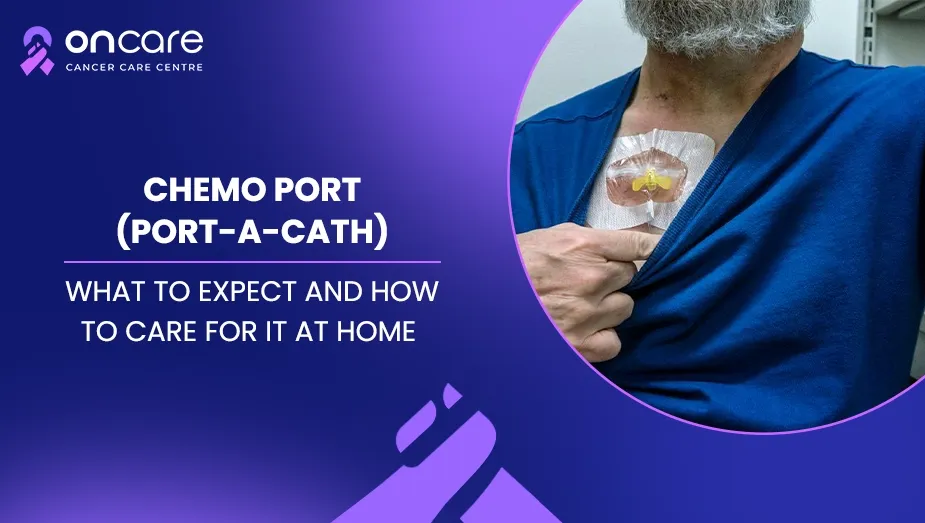

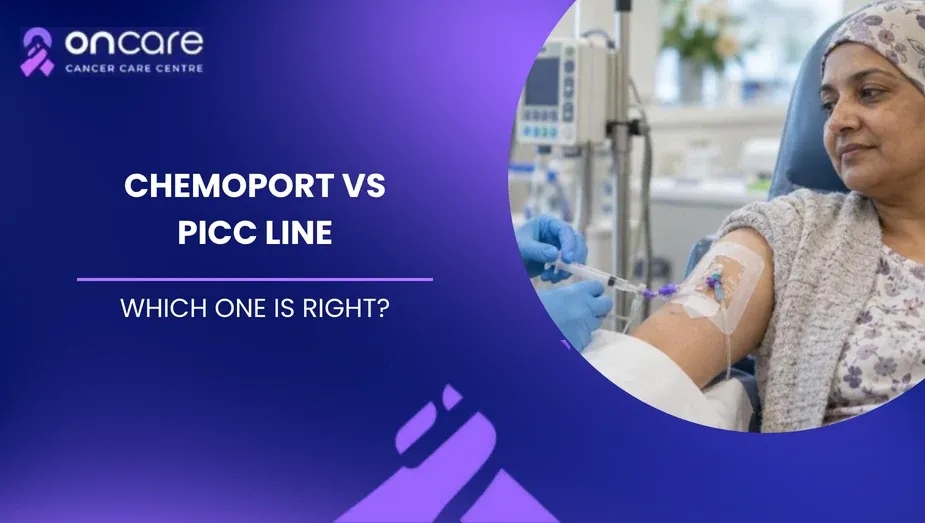
A chemoport sits fully under the skin of the chest and can stay for months or years. A PICC line goes in through a vein in the upper arm, has a tube outside the body and is usually used for weeks to months. But both have their own set of features and differences in placement and use.
The patients are usually concerned about which device feels more comfortable and how long they stay inside the body, as well as how they interfere with the patient’s activities like bathing, sleeping and working.
The selection of one device versus another will depend on the type of cancer therapy, the length of time the therapy will take place, the condition of the vein as well as the overall health status of the patient. The following blog explains chemoport vs PICC line, highlighting the key differences between these devices and the criteria to consider when selecting one of them.
What Is a Chemoport?
A chemoport (also known as an implanted port or Port-a-Cath) is a small device which is placed under the skin (typically in the upper chest). It provides access to a large vein for the delivery of prescribed treatment. It has two main parts:
Port reservoir: A small chamber with a self-sealing silicone centre (a septum). It's situated beneath the skin and is the access point.
Catheter: A thin, flexible tube which runs from the reservoir. It delivers the medication into a large vein.
The device stays under the skin so there's no external tube when it's not in use. A trained health professional will access it by inserting a special non-coring needle through the skin into the reservoir. A chemoport for cancer patients can be used for chemotherapy, for various IV medications, fluids and blood sampling where appropriate. It can stay in place for months or indeed years if it's working well and is still required.
What Is a PICC Line?
Peripherally Inserted Central Catheters are known as PICC lines. It is a thin, soft tube put into a vein in the upper arm and passed up to a large vein near the heart. A PICC line has an external part that remains outside the body compared to a chemoport. It is covered with a sterile dressing and secured to the arm. There are one or more lumens, or access points, at the external end of the PICC line from which medications and fluids are administered. Some of the purposes for which the use of a PICC line may be appropriate are as follows:
- Certain types of chemotherapy medications.
- IV antibiotics and other medications.
- IV fluids and nutrition.
- Collection of blood, if required.
- Administration of blood products, if required.
It is considered when a person needs central venous access for several weeks or months. A qualified medical practitioner can easily insert the device without surgery.
Chemoport vs PICC Line: What Are the Main Differences?
Both devices deliver medicine into a large central vein; however, each device has features that influence how the patients interact with the devices.
Comparison factor | Chemoport | PICC line |
|---|---|---|
Placement | Under the skin, usually in the chest | Through a vein in the upper arm |
External tubing | No external tube when not accessed | Part of the catheter remains outside |
Access method | Special needle inserted into the port | IV tubing connected to the external end |
Insertion | Minor procedure involving an incision | Usually inserted through a small arm-vein access point |
Appearance | Small raised area beneath the skin | Visible tube and dressing |
Dressing care | Needed during healing and when accessed | Regular dressing care required |
Bathing | Generally easier after healing when not accessed | Must protect the line and dressing from water |
Maintenance | Flushing at recommended intervals | Flushing, dressing and connector care |
Typical duration | May remain for months or years | Often used for weeks to months |
Removal | Minor procedure | Usually removed by a trained professional |
The time needed for maintenance will depend on the device and the condition of the patient.
How Is a Chemoport Inserted?
Chemoport insertion is generally performed in a clinical setting either by a surgeon or interventional radiologist. It is usually done under local anaesthesia. This procedure is done using the following steps:
Cleansing of the site: The chosen site of insertion which is usually the upper chest is cleansed using antiseptic solution.
Creating the pocket: The physician will make a pocket under the skin where the reservoir will be inserted using an incision.
Insertion of the catheter: A small tube is placed in the large vein using imaging guidance.
Attaching the device: The tube will then be attached to the reservoir that will be inserted under the skin.
Positioning check: Before using the catheter, the health care team ensures that it is properly positioned.
How Is a PICC Line Inserted?
Placement of a PICC line is less invasive than the insertion of a chemoport into the patient's body. PICC lines are placed either by nurses or doctors. Steps of the procedure include the following:
Identification of the vein: An ultrasound is used to identify the vein to be punctured in the upper arm.
Cleaning and numbing: The area is cleaned with the antiseptic solution, and local anaesthetic is applied.
Catheter placement: The flexible catheter is passed through the vein into the central circulation.
Confirmation of its location: This can be done by the use of an X-ray, ECG guidance, or other methods which are approved.
Securing the catheter: The external part of the line is secured, and sterile dressing is applied on it.
The PICC line is only used after confirmation of its proper location. There may be some pain in the puncture area.
Why Might a Cancer Patient Need a Chemoport or PICC Line?
A central venous access port is not needed by all cancer patients since some medications can be given using a normal IV cannula. However, frequent cannulation may prove problematic, and some drugs will necessitate central venous access. The following are some reasons why doctors prescribe chemoports or PICC lines:
Repetition of chemotherapy: When a patient is undergoing IV therapy over several months, it becomes essential for them to have reliable venous access to a large vein.
Hard-to-find veins: Some patients have veins that are hard to find or to use again and again.
Requirement for specific medication: There are some medicines that might be more effectively administered using central access due to their concentration or other characteristics.
Frequent supportive treatment: People who receive repetitive antibiotic therapy or fluids or other blood products also require reliable venous access.
Medication requiring prolonged administration: Some medicines are delivered for many hours or even days.
The oncologist will consider the treatment plan for the patient before choosing which device to use.
What Are the Benefits of a Chemoport?
Implanted Port could prove useful for those patients who require multiple administrations of IV therapy in the long term.
1. Reduced repetitions of needle pricks
With a special needle, a skilled medical practitioner would be able to have access to the port rather than a new IV cannula at every session.
2. Absence of any external tube during non-usage time
This apparatus remains under the skin until it is needed for administration of therapy.
3. Can be used for long periods of time
If the chemoport is working well, it can last for months or even years.
4. Dressing care is not necessary
If there is no need to access the chemoport, after the wound heals, you will not have to change your catheter dressings on a regular basis.
5. You can bathe normally
You will be able to shower normally after the wound heals and once there is no needle attached to the catheter.
What Are the Benefits of a PICC Line?
When central venous access is needed without an implanted port, a PICC line may be helpful to the patient.
1. There is no reservoir implanted in the body
The catheter is inserted via an arm vein and does not need a pocket under the skin.
2. It can provide various IV therapies
Depending on its structure, it can provide prescribed antibiotics, fluid therapy, and chemotherapy with other medicines.
3. May have multiple lumens
There are some PICC catheters that are designed with more than one channel in order to facilitate administration of compatible drugs or fluid through the same catheter.
4. It can be used for a designated period of treatment
It can be useful when central access will be required for weeks or months, not for a long period of time.
Possible Complications of a Chemoport
Both devices can cause problems. Correct insertion, clean care and regular checks lower the risk.
Infection: The bacteria may penetrate either through the place of insertion of the port or when accessing the port. Symptoms of infection are: fever, redness, swelling, and tenderness.
Formation of blood clots: A blood clot can be formed in the vein into which the catheter is placed. As a result, there may be pain in the arm, shoulder, or neck.
Bleeding and bruising: There might be some bruising after the process of insertion. The constant bleeding and/or swelling requires assessment.
Blockage: The blood or medication can form a blockage in the catheter.
Catheter movement: The catheter can move out of position and may need to be checked or fixed.
Some rare complications from the catheter insertion procedure might include an injury to a blood vessel or punctured lung.
Possible Complications of a PICC Line
Infection in the bloodstream: Bacteria can enter via the insertion site or any connections made from outside.
Blood clots: A blood clot can form in the vein in the arm leading to pain, warmth or swelling.
Blockage of the catheter: The catheter can be difficult to flush or access.
Displacement: Any pulling or movement can lead to displacement of the catheter.
Skin irritation: This is caused by adhesive dressings or securing devices.
Neither device is entirely safe from infection and clotting problems. The chances of these problems happening depend on the health of the patient and how long the catheters are used.
How Should Patients Care for a Chemoport and PICC Line?
The care procedures are different because the chemoport is under the skin and the PICC line has an external part. Patients need to follow the directions of their hospitals.
Chemoport Care Tips
- Make sure the insertion site stays clean and dry.
- Only trained professionals should have access to the port using the proper needle.
- Flushing should be done according to the schedule given for when the port is not being used.
- Do not rub or apply creams to the port site unless you are instructed.
- Take note of any signs of irritation like redness, swelling, pus, and tenderness.
- Engage in strenuous activity only if it is confirmed with the doctor.
Once recovered, patients will be able to do normal activities. However, strenuous activities which might directly affect the insertion site should be discussed with the doctor. For more information, read our guide on chemo port care to understand the precautions and steps patients should follow after port insertion.
PICC Line Care Tips
- Maintain a clean, dry, and secure dressing.
- Avoid any contact of water with the catheter while taking a bath or shower.
- Make sure that the visits for catheter care are followed up, which include changing dressings and connections.
- Stick to the given catheter flushing regimen.
- Do not pull, twist, or apply pressure to the external catheter tube.
- Keep away sharp objects from the catheter.
- Do not reinsert a dislodged catheter back into place.
In case of moist or damaged dressing, inform your healthcare provider. It may need changing by applying sterile technique.
Chemoport vs PICC Line: Which One Is Better for Long-Term Chemotherapy?
The choice would depend on the anticipated length of time and frequency of infusions and medications.
A chemoport is a good choice if the treatment is repeated and is for a prolonged period but with intervals between the infusions. The implanted nature of this device makes it easier for the patient to go about their daily routine.
PICC placement is appropriate when central venous access is required for a temporary to moderate amount of time, as well as when there is a requirement for repeated venous access and the patient is able to tolerate the catheter externally.
Treatment situation | Option the doctor may consider |
|---|---|
Chemotherapy every few weeks over an extended period | Chemoport |
IV antibiotics for a defined period | PICC line |
Long-term treatment with occasional infusions | Chemoport |
Multiple compatible infusions requiring separate lumens | Multi-lumen PICC line or another suitable device |
Patient unsuitable for port implantation | PICC line or another access device |
This is just a general guideline and not an absolute rule because the physician can choose any kind of central venous catheter depending on personal requirement.
Can a Patient Switch from a PICC Line to a Chemoport?
Yes. There will be times where a patient will switch from a PICC line to a chemoport depending on their treatment plan.
For instance, there could be a situation where a patient first requires a PICC line but ends up needing chemotherapy for a few months in addition. The oncologist may then opt to insert a chemoport after evaluating the need and safety of the procedure.
Before making the suggestion to place a chemoport, the healthcare professionals take into consideration the state of veins of the patient, their treatment plan and whether they had any complications with the catheter. The PICC line is removed once it is determined that the line is not needed anymore.
It is not always necessary to switch. In some cases, there would be no need for switching if the currently functioning PICC line can still be useful.
Which Factors Does Your Doctor Consider Before Choosing?
The choice is not only based on the comparison of the processes of placement but also on other medical criteria.
1. Length of the Therapy
In the case of the necessity to use a long-lasting therapy, an implanted port can be used; whereas a PICC line is useful in the case of a medium or short length therapy.
2. The Frequency of Infusions
Patients with weekly or two-week infusions over a long time may benefit from a port. The patients with frequent or constant infusions are candidates for a PICC line or any other medical equipment.
3. Type of Cancer Drugs
The concentration of the drug along with its attributes and the mode of administration helps decide whether central access is required.
4. Vein and Blood Vessel Health
Past instances of clotting, vein narrowing, or complications from using catheters will be considered while making the selection.
5. Risk of Infections and Clots
The patient's health profile assists the doctor in anticipating the complications and monitoring appropriately.
6. Daily Activities and Personal Preference
While some patients prefer the implant under their skin, some patients may not want to undergo any implantation surgery. The convenience of managing the external line by oneself is also taken into consideration.
7. Follow-up Care Availability
The PICC line requires frequent dressing changes and maintenance. The chemoport has access and flushing needs that are different. The medical team looks into the ability of the patient to attend these appointments.
When Should a Patient Contact the Doctor?
The patient must alert the healthcare provider of any unusual changes related to either catheter instead of waiting for the next session of chemotherapy treatment.
- Warmth, redness, swelling, pain around the insertion site.
- Presence of pus/discharge.
- Swelling or pain in the arm, shoulder or neck.
- Leaking/catheter damage.
- Inability to flush the line.
- Change in catheter length/position in case of a PICC line.
- Pain during infusion.
Seek immediate medical care if you suddenly experience shortness of breath, chest pain, passing out, or extreme dizziness since this might be a sign of a potentially life-threatening condition. In case the PICC line gets pulled out by mistake or seems to have been displaced, do not try pushing it back into place. Seek medical help right away.
Consult Today
Selection of a chemoport over a PICC line is determined by the nature of the cancer treatment, health condition of the patient, and the length of time that the IV therapy will be needed. The oncologist can make this assessment and advise on the appropriate choice for you.
For information on cancer treatment and supportive services, contact the experts at Oncare Cancer Hospital. Talk to the doctors about your needs and requirements for treatment.
Disclaimer
The following content is provided for educational purposes only and is not to be considered as professional medical advice or treatment. Every patient will have a varying level of appropriateness regarding the use of a chemo port or PICC line. Please speak with your oncologist before making any decisions concerning treatment.
Frequently Asked Questions
Is it possible for a patient to sleep normally with a chemoport or PICC line?
Yes, most patients will sleep normally once they get used to the device. However, they should not exert any direct pressure on the insertion point and should not pull the external PICC line tubing.
Which one is safer – chemoport or PICC line?
Neither device is risk-free. While ports tend to have fewer cases of catheter-related infections and blood clots, it varies from one clinical setting to another, based on patient condition and device management.
Can chemoport or PICC lines be removed after chemotherapy?
Yes. PICC lines can usually be easily removed while a chemoport is removed with a minor procedure under local anaesthesia.