Table of Contents
Testicular Cancer: Self-Exam and Early Warning Signs

By Dr. Gajendra Kumar Himanshu


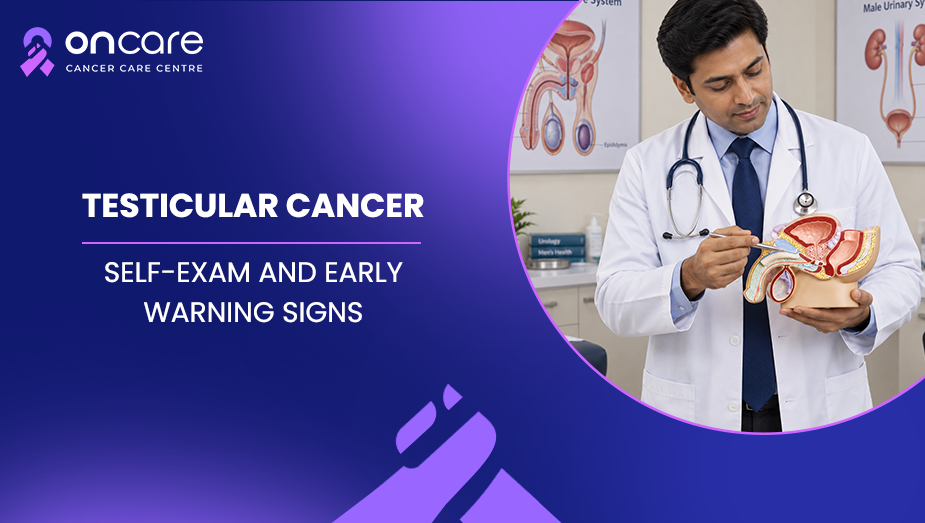
Testicular cancer is rare, but it occurs most commonly in young men, particularly those aged 20 to 34 years. A warning sign can be a lump that does not hurt, swelling, a change in the size or feel of a testicle, or heaviness or discomfort in the scrotum. There is no routine screening test recommended for men without symptoms, so it is important to notice a new change and have it evaluated promptly.
In this blog, we discuss the early warning signs of testicular cancer, what changes you might notice in the testicles and scrotum, and when to see a doctor. We also explain what a self-check can and cannot tell you, how testicular cancer is diagnosed, and why early medical assessment matters.
Why It Is Important to Recognise the Early Signs of Testicular Cancer
Testicular cancer is uncommon compared with many other cancers, yet it is one of the most common cancers in young men. Most testicular cancers begin in germ cells, the cells that produce sperm. The encouraging part is that testicular cancer is highly treatable, and many cases can be treated successfully even when the disease is found at an advanced stage.
The disease may show itself as a change in the testicle that causes no pain. Knowing what is normal for you can make it easier to notice something unusual. However, a change in the testicle does not always mean cancer. Cysts, infections, fluid build-up and other non-cancerous conditions can cause similar symptoms.
What Are the Early Signs of Testicular Cancer?
The symptoms of testicular cancer can vary, and some men notice a change by accident.
A Lump or Swelling in the Testicle
One of the most common symptoms of testicular cancer is a painless lump or enlargement in a testicle. The lump may feel hard or different from the rest of the testicle. It may not hurt at all, which is why a new lump should not be dismissed simply because it is painless.
A Change in the Size or Feel of the Testicle
You may notice that one testicle looks or feels larger, smaller, firmer or simply different from before. A change in the texture or shape of a testicle can have many causes, but it needs a medical examination if it is new or persistent.
Pain or Discomfort
Testicular cancer usually does not cause pain. Some patients do feel pain or discomfort in the testicle or scrotum. Pain alone does not mean cancer, but unexplained or persistent pain should be evaluated.
Fluid Build-Up or a Feeling of Heaviness
Some men notice a heaviness in the scrotum or a sudden collection of fluid around a testicle. These symptoms occur in many conditions, but a new change should be assessed rather than assumed to be harmless.
A Dull Ache in the Lower Abdomen or Groin
A dull ache in the groin or lower abdomen can be a sign of testicular cancer, although there are many other possible reasons for it. If the symptom persists, or occurs along with a lump in the testicle, medical assessment is recommended.
What Can a Testicular Self-Exam Tell You?
There is an important difference between knowing your own body and undergoing a formal cancer screening test. Self-examination is not a screening programme, and it cannot confirm or rule out cancer.
This does not mean that changes should be ignored. Being familiar with how your testicles normally look and feel can help you notice when something is different.
How to Check for Unusual Changes
Step | What to Do |
|---|---|
Choose the right time | A self-check can be done gently, usually after a warm shower when the scrotal skin is relaxed. |
Check each testicle | Hold each testicle between your fingers and roll it slowly to check for any new lumps, swelling or changes in firmness. |
Know what is normal | It is normal for one testicle to hang a little lower, or to be slightly larger than the other. |
Know the epididymis | The epididymis is a soft tube-like structure just behind each testicle. It is a normal part of the anatomy and should not be mistaken for a lump. |
Remember the purpose | The aim is not to diagnose cancer yourself. It is simply to notice a change that should be reviewed by a healthcare professional. |
When Should You See a Doctor?
Any new lump, swelling or change in a testicle should be evaluated, particularly if it persists or occurs with other symptoms. Do not wait for pain before seeking care, because testicular cancer may cause no pain at all.
You should see a doctor for a new lump in the testicle, ongoing swelling, a change in the size or firmness of a testicle, unexplained pain or discomfort, a sudden build-up of fluid in the scrotum, or a persistent ache in the groin or lower abdomen.
Sudden, severe testicular pain is a different matter. It may be a sign of testicular torsion, which is a medical emergency and needs immediate treatment.
How Is Testicular Cancer Diagnosed?
Doctors usually start with a physical examination and questions about the symptoms and when they began. A testicular ultrasound is often done to assess an abnormal area. Blood tests may also be done to measure tumour markers that can be associated with certain testicular cancers.
If cancer is suspected, the doctor uses the physical examination, imaging, blood tests and other information to establish the diagnosis and stage. Surgery to remove the affected testicle is usually part of the process. The treatment that follows depends on the type and stage of the cancer.
Who Is at Higher Risk of Testicular Cancer?
Several factors are associated with a higher risk. These include a history of an undescended testicle and certain previous testicular conditions. A family history may also be relevant. However, many men who develop testicular cancer have no obvious risk factor.
If you have a higher-risk history, discuss it with a doctor, who can advise on appropriate examination and follow-up.
For more information regarding testicular cancer, visit the National Cancer Institute.
Consult Today
If you have found a new lump or swelling, a change in the size or firmness of one or both testicles, or ongoing pain, it is better to find out the cause sooner rather than later. At Oncare Cancer Hospital, patients can consult the specialist team about changes in the testicles and receive support with examination, ultrasound, diagnosis and treatment when required.
Disclaimer
This blog is for educational purposes only and does not replace professional medical advice, diagnosis or treatment. Any persistent change in a testicle requires individual evaluation to determine its cause. Consult a qualified doctor for personalised advice.





Frequently Asked Questions
One of the most common warning signs is a painless lump or enlargement in a testicle. Other changes can include a difference in size or feel, pain, fluid build-up, or a dull ache in the groin or lower abdomen.
There is no routine screening programme for testicular cancer in men without symptoms, and research has not shown that regular self-examination reduces deaths from the disease. However, knowing what is normal for you can help you notice a new change and seek medical attention.
No. Several non-cancerous conditions can cause testicular lumps or swelling. However, a new lump should still be investigated, because the cause cannot be identified reliably by self-examination alone.
Yes. Testicular cancer is highly treatable, and many cases can be treated successfully, including some that are found after the cancer has spread. Treatment depends on the type of cancer and its stage.
Written and Verified by:
Dr. Gajendra Kumar Himanshu Exp: 10 Yr
Medical Officer
Book an Appointment
Related Blogs

Immune-Related Side Effects of Immunotherapy: What to Watch For
Learn the immune-related side effects of immunotherapy, warning signs, diagnosis, treatment, and when to seek urgent care at Oncare Cancer Hospital.

Active Surveillance: When Doctors Choose to Watch Instead of Treat
Learn what active surveillance means in cancer, how it differs from watchful waiting, its benefits, monitoring, and treatment planning at Oncare Cancer Hospital.
Maintenance Therapy: Keeping Cancer in Remission After Treatment
Learn what maintenance therapy is, how it helps prevent cancer recurrence, its benefits, side effects, and follow-up care at Oncare Cancer Hospital.