Table of Contents
Surgical Margins in Cancer: What Clear Margins Really Mean

By Dr. Gajendra Kumar Himanshu


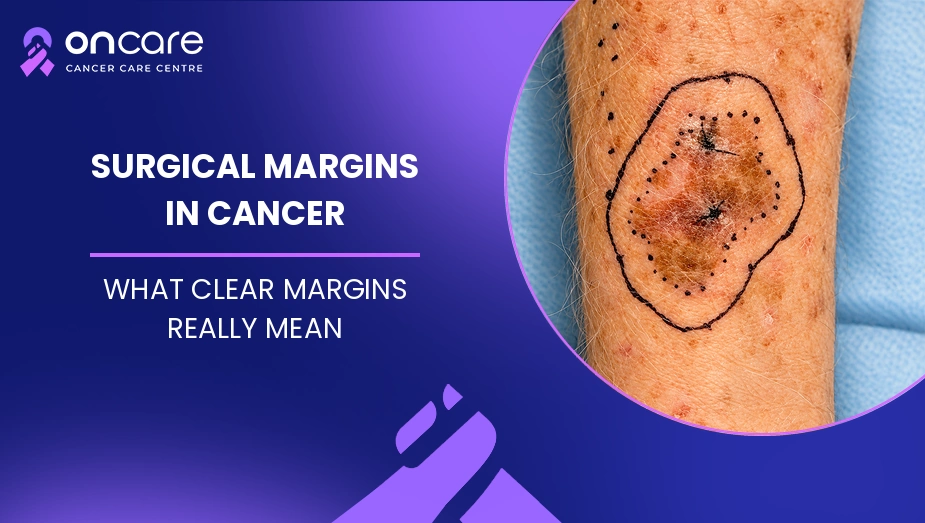
Surgical margins are the edges of the tissue removed during cancer surgery. A clear or negative margin means that the pathologist did not find cancer cells at the edge of the removed tissue. This usually suggests that the tumour has been completely removed from that area, although clear margins do not guarantee that cancer will never come back. A positive or involved margin means cancer cells are present at the edge and may suggest that some cancer remains in the body.
When patients receive a pathology report after cancer surgery, words such as clear margin, negative margin, positive margin, or close margin can be confusing. Understanding these terms can help you understand your treatment better.
In this blog, we will explain what surgical margins mean, how doctors check them, what clear and positive margins mean, what happens when margins are close or positive, and why margin status is only one part of the cancer treatment plan.
What Are Surgical Margins?
When a surgeon removes a cancerous tumour, the goal is usually to remove the tumour along with some surrounding tissue. This surrounding tissue is checked to see whether cancer cells have reached the outer edge of the removed specimen.
The outer edge is called the surgical margin. A pathologist examines the removed tissue under a microscope and reports whether cancer cells are present at the margin.
Doctors may remove some normal-looking tissue around a tumour because cancer cells can sometimes extend beyond what can be seen during surgery. The amount of tissue removed depends on the type, size and location of the cancer and the goal of the operation.
If you want to understand more about pathology reports, you can read this simple guide on how to read a pathology report.
What Does a Clear or Negative Margin Mean?
A clear margin, also called a negative or clean margin, means that the pathologist did not see cancer cells at the edge of the tissue removed during surgery.
This is generally a good result because it suggests that the cancer was removed from that area with a border of tissue around it.
However, a clear margin does not mean that there is zero chance of cancer returning. Cancer can sometimes come back because of microscopic cells elsewhere in the body that cannot be seen or removed during surgery.
This is why doctors may still recommend other treatments, such as chemotherapy, radiation therapy, hormone therapy, or targeted therapy, depending on the cancer type and stage.
What Does a Positive Margin Mean?
A positive margin, also called an involved margin, means cancer cells were found at the edge of the removed tissue. This can suggest that some cancer cells may remain in the body near the area where the tumour was removed.
A positive margin does not automatically mean that cancer has spread to other organs. It specifically describes what was found at the edge of the surgical specimen.
Depending on the cancer type and location, the doctor may recommend another surgery to remove more tissue, radiation therapy, or another treatment. The best option depends on the individual case.
For patients who want to understand why surgery is an important part of cancer treatment, this guide on why surgery is crucial in cancer treatment can be helpful.
What Is a Close Margin?
A close margin means the cancer is near the edge of the removed tissue but does not actually reach it. The meaning of close can vary depending on the type of cancer, the body part involved, and the treatment guidelines being followed.
For some cancers, doctors may pay close attention to the exact distance between the cancer and the margin. For others, the important question may simply be whether cancer reaches the edge. Therefore, there is no single margin distance that is considered close for every cancer.
Your doctor will interpret the margin based on your specific cancer rather than looking at the number alone.
Clear vs Positive vs Close Margins
These terms can be easier to understand when compared side by side.
Margin result | What it means | What it may mean for treatment |
|---|---|---|
Clear/negative | No cancer cells found at the edge | Often means no cancer was found at the surgical edge |
Positive/involved | Cancer cells found at the edge | Further treatment may be considered |
Close | Cancer is near the edge but does not touch it | Depends on cancer type, distance, and other findings |
Uncertain | Margin cannot be assessed clearly | More testing or discussion may be needed |
A margin result should always be considered along with the complete pathology report, cancer stage, tumour type and other findings.
How Are Surgical Margins Checked?
After surgery, the removed tissue is sent to a pathology laboratory. A pathologist examines the specimen and looks at the tumour and its surrounding tissue under a microscope.
The outer surface of the specimen may be marked with ink so the pathologist can identify the actual surgical edge. The report can then state whether cancer cells are present at that edge.
In some surgeries, doctors may also use a frozen section during the operation. This allows tissue from the suspected margin to be examined quickly while surgery is still taking place. If cancer cells are found, the surgeon may be able to remove additional tissue during the same operation when it is safe and appropriate.
What Happens If the Margin Is Positive?
If the pathology report shows a positive margin, it does not always mean that another operation is immediately required.
Doctors consider several factors, including:
- The type and location of cancer
- Which margin is involved
- How much cancer is present at the margin
- Whether another surgery can be performed safely
- Whether radiation or another treatment is appropriate
- The overall stage and features of the cancer
For some cancers, another surgery may be recommended to remove additional tissue. In other situations, radiation or another treatment may be considered instead.
The decision should therefore be made by the treating cancer team after reviewing the complete pathology report.
Do Clear Margins Mean Cancer Is Cured?
Clear margins are an important and positive finding, but they do not by themselves mean that cancer is cured.
Cancer treatment decisions are based on many factors. The pathology report may also provide information about tumour type, grade, lymph nodes and other features that help doctors understand the cancer and plan further treatment.
For example, a patient may have clear surgical margins but still need chemotherapy or radiation because the cancer has other features that increase the risk of recurrence.
Similarly, a positive margin does not automatically mean that treatment has failed. There may be effective options to reduce the chance of the cancer returning.
Why Are Clear Margins Important?
The main goal of cancer surgery is to remove the visible tumour while preserving as much healthy tissue and normal function as safely possible. Achieving a cancer-free margin can reduce the chance of cancer remaining at the original surgical site.
However, surgeons must also balance cancer control with the patient's safety and quality of life. In some locations, removing a very large amount of normal tissue could damage important organs, nerves, or other structures.
This is why the meaning of a margin depends on the cancer and the location of the tumour.
What Should You Ask Your Doctor About Your Margins?
If you have received your pathology report, ask your cancer specialist to explain the margin section in simple words.
Useful questions include:
- Are my margins clear or positive?
- If the margin is close, how close is it?
- Do I need another surgery?
- Will I need radiation or another treatment?
- Does my margin result change my cancer stage or treatment plan?
If you want to read more about surgical margins, you can visit the National Library of Medicine.
Consult Today
Surgical margins are an important part of a cancer pathology report. A clear or negative margin means no cancer cells were found at the edge of the removed tissue, while a positive margin means cancer cells were found at that edge. However, margin status is only one part of the complete cancer picture.
At Oncare Cancer Hospital, patients can discuss their pathology reports, surgical margins, cancer stage, and further treatment options with a cancer care team. If your report mentions a positive margin, a close margin, or a clear margin and you are unsure what it means for your treatment, speak with a cancer specialist before making any decisions.
Disclaimer
This information is for educational purposes only and does not constitute medical advice, diagnosis, or treatment. A margin result should be interpreted along with the complete pathology report and each patient's overall condition. Always discuss your report and treatment decisions with a certified cancer healthcare provider.





Frequently Asked Questions
Yes, it means no cancer cells were found at the edge of the removed tissue, which generally suggests that the tumour was removed from that area.
No, a positive margin means cancer cells were found at the edge of the tissue removed during surgery. It does not by itself show that cancer has spread to distant organs.
Not always. Depending on the cancer, doctors may consider another surgery, radiation therapy, or other treatment.
Yes, clear margins reduce the risk of cancer remaining at the surgical site, but they cannot eliminate the possibility of recurrence. Other cancer features and treatments also affect the risk.
Written and Verified by:
Dr. Gajendra Kumar Himanshu Exp: 10 Yr
Medical Officer
Book an Appointment
Related Blogs

Feeding Tubes During Cancer Treatment: NG Tube and PEG Explained
Learn about NG and PEG feeding tubes during cancer treatment, including their uses, differences, care, risks, and nutrition support at Oncare Cancer Hospital.

Autologous vs Allogeneic Stem Cell Transplant: Key Differences Explained
Understand autologous and allogeneic stem cell transplants, including differences, benefits, risks, donor matching, and recovery at Oncare Cancer Hospital.

Bone Marrow Biopsy: Why It Is Done and What to Expect
Learn why a bone marrow biopsy is done, how the procedure works, pain, preparation, recovery and test results with expert guidance at Oncare Cancer Hospital.