Table of Contents
Breast Cancer Staging: TNM and Stages 0–IV

By Dr. Gajendra Kumar Himanshu


The stage of breast cancer describes how far the breast cancer has grown or spread in the body. Doctors use the TNM staging approach to figure out the size of the tumor (T), whether lymph nodes are involved (N), and if the Cancer has spread to other organs (M). Accurate staging helps to decide the best treatment strategy, prognosis, and to guide decisions about Surgery, Chemotherapy, Radiation Therapy, and other treatments.
What is the breast cancer stage?
When Breast Cancer is diagnosed, one of the first questions patients ask is “What stage is my Cancer?”
Breast Cancer staging is the process of identifying the extent of the disease. It helps doctors see how big the tumor is, whether neighboring lymph nodes are involved, and whether the Cancer has spread to other parts of the body.
The Stage of Breast Cancer is very essential in deciding the best treatment plan. But staging is just one piece of treatment planning. Doctors also look at tumor biology, hormone receptor status, HER2 status, general health, and age.
What Is the Purpose of Staging Breast Cancer?
To decide which treatments are appropriate and to explain what care will be like, clinicians need to know the stage of the disease. Staging of breast cancer helps to:
- Choose the best treatment strategy
- Surgery: Determine whether possible
- Determine the Need for Chemotherapy or Radiation Therapy
- Assess the necessity for targeted therapy or Immunotherapy in selected cases
- Follow-up of illness progression
- Allow healthcare providers to communicate
Proper staging helps tailor treatment to the individual and not a cookie-cutter approach.
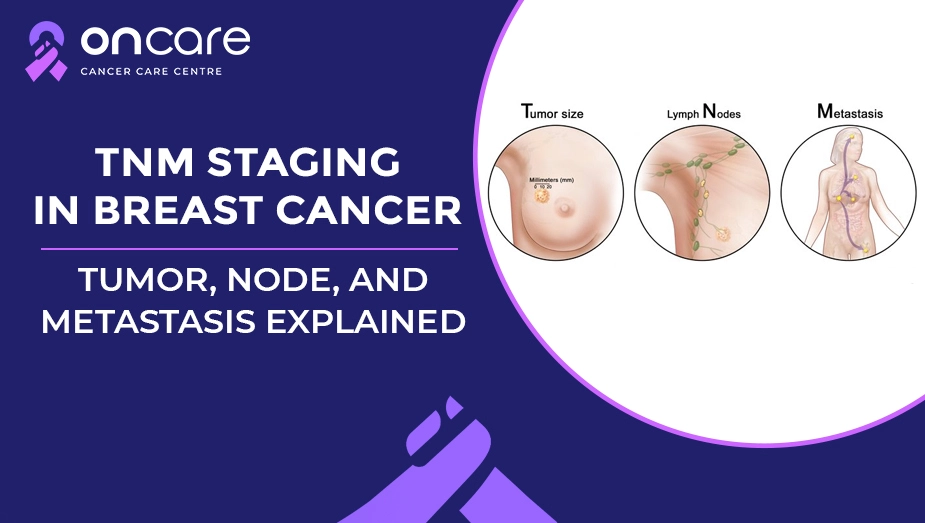
What Is the TNM Staging System?
The TNM staging system, which is widely approved, is used to describe Breast Cancer.
T (Tumour)
T category: Describes the size of the main tumour and if it has grown into adjacent tissues.
In general:
- The lower the T number, the smaller the tumor.
- Larger tumors or more local growth is indicated by higher T values.
N (Nodes)
The N (lymph node) category explains whether the cancer has migrated to surrounding lymph nodes, especially those in the underarm or near the collarbone.
The N stage is based on the number of lymph nodes involved. The more lymph nodes involved, the higher the N stage.
M (Metastases)
The M category determines whether the Cancer has migrated beyond the breast and local lymph nodes into distant organs, including:
- Bones
- Liver
- Lungs
- Brain
M0 - no evidence of distant dissemination.
M1 - metastatic illness.
Breast Cancer Stages 0 to IV Explained
Doctors then stage the overall cancer based on the results of the TNM findings.
Stage 0 Breast Cancer
Stage 0 is called non-invasive Breast Cancer.
At this stage:
- Abnormal cells are left in the milk ducts.
- The Cancer has not spread into the surrounding breast tissue.
- It is also called Ductal Carcinoma in Situ (DCIS).
Surgery is often used as a treatment, and some patients may additionally need radiation therapy depending on the case.
Breast Cancer Stage I
Stage I is early Breast Cancer. Characteristics might include:
- A little tumor
- Minimal or absent lymph node involvement
- No distant dissemination
At this time, patients often have multiple viable treatment options.
Breast Cancer Stage II
Stage II Breast Cancer often signifies the cancer has become bigger or has migrated to several adjacent lymph nodes.
Treatment may include:
- Surgical
- Chemotherapy
- Radiation Treatment
- Hormone Therapy
- Targeted therapy as indicated
The biology of the tumor is the basis for therapy decisions rather than the stage alone.
Breast Cancer Stage III
Stage III is known as locally advanced Breast Cancer.
Cancer may include:
- Bigger tumors
- Several lymph nodes
- Breast tissues are closing nearby
Stage III breast cancer, which is more advanced, is usually treated with a mix of medicines.
Patients may get:
- Neoadjuvant Chemotherapy
- Surgery
- Radiation Therapy
- Hormone replacement therapy
- Targeted Therapy or Immunotherapy for selected patients
Breast Cancer Stage IV
Stage IV Breast Cancer is sometimes called metastatic Breast Cancer. At this stage, cancer has spread to distant organs like:
- Bones
- Liver
- Lungs
- Brain
Treatment aims to control the condition, relieve symptoms, maintain quality of life, and allow patients to live as well as possible for as long as possible.
How is Breast Cancer Staged by Doctors?
Doctors consider the results of many tests before assigning a stage.
Tests often include:
- Physical examination
- Mammography and Breast Ultrasound
- MRI
- Biopsies
- CT Scan
- Positron Emission Tomography (PET) Scan
- Bone Scan as stated
- Blood tests
Not every patient needs every test. The investigation depends on the particular circumstances. To know more about Breast Cancer staging, visit the official website of the National Cancer Institute.
Breast Cancer Staging at a Glance
Stage | Description |
|---|---|
Stage Zero | Non-invasive Cancer within the milk ducts |
Phase I | Small invasive tumor with minimal or no lymph node involvement |
Second Stage | Larger tumor size and/or less nodal involvement |
Stage III | Locally Advanced Cancer that has spread to surrounding tissues or to several lymph nodes |
Phase 4 | The cancer has spread to distant parts of the body |
Does the Stage Ever Change?
The stage designated at diagnosis is typically the stage that is documented in a patient’s medical record throughout their care.
Doctors often use the original stage of Cancer to describe the recurrent or metastatic disease, even if it returns or spreads later. This helps to ensure uniformity in treatment planning and medical documentation.
Does Early Detection Change the Stage?
Yes. Finding breast cancer early typically involves diagnosing it before it has spread. Regular screening and early evaluation of symptoms may help to detect Cancer at an earlier stage.
If you see:
- A new lump in the breast
- Breast shape changes
- Skin puckering
- Discharge from the nipple
- Breast pain that does not resolve
- Armpit swelling
Talk to your doctor. Early medical assessment provides for timely diagnosis and treatment strategy.
Myths About Breast Cancer Staging
Myth | Fact |
|---|---|
It depends on the stage. | Management depends on tumor biology, hormone receptor and HER2 status, and general health. |
Stage IV means there is no treatment. | There are many treatments to help control metastatic Breast Cancer and enhance quality of life. |
All patients with Stage II disease are treated the same. | Treatment is tailored according to a variety of medical considerations. |
A bigger tumor always signifies a worse prognosis. | Tumor biology and treatment response are also essential. |
Consult Today
Finding out the stage of your breast cancer is a critical step in deciding on treatment options. Getting the right stage means your oncology team can suggest a treatment plan that’s right for you, based on your specific diagnosis and general condition.
Our team of multi-disciplinary professionals at Oncare Cancer Hospital supports patients through every stage of Breast Cancer care, using innovative diagnostic tools and evidence-based treatment approaches. If you have just been diagnosed or are looking for a second opinion on your staging or treatment plan, speak to an expert oncology team for information tailored to you.





Frequently Asked Questions
TNM is an abbreviation for Tumor (T), Nodes (N), and Metastasis (M). This is the most commonly used system to define the size of the tumor, if lymph nodes are involved, and whether Cancer has spread to distant organs.
Yes. Stage 0 Breast Cancer is most often Ductal Carcinoma in Situ (DCIS). This means the abnormal cells are restricted to the milk ducts of the breast and have not spread into the adjacent breast tissue.
Doctors may utilize a combination of tests that include physical examination, biopsy, MRI, mammography, ultrasound, CT scan, PET scan, and other imaging procedures, depending on the state of the patient.
The stage assigned upon diagnosis usually does not change. If the cancer comes back or spreads later, then it is called recurrent illness or metastatic disease. The original stage is still in the medical record.
Written and Verified by:
Dr. Gajendra Kumar Himanshu Exp: 10 Yr
Medical Officer
Book an Appointment
Related Blogs

Managing Hot Flashes After Hormone Therapy for Breast Cancer
Learn how to manage hot flashes after hormone therapy for breast cancer with simple lifestyle tips, emotional support, and expert care guidance for recovery.

Breast Cancer Signs Women Shouldn't Ignore
Know breast cancer warning signs women shouldn't ignore. Oncare Cancer Hospital shares early symptoms, risks, and when to consult a doctor for care.

TNM स्टेजिंग सिस्टम क्या है? जानिए ब्रेस्ट कैंसर कितने दिन में फैलता है
TNM स्टेजिंग सिस्टम क्या है, ब्रेस्ट कैंसर में T, N और M का क्या मतलब होता है, कैंसर कितनी तेजी से फैलता है और सही स्टेज से इलाज कैसे तय होता है, जानिए विस्तार से।
TNM Staging in Breast Cancer: Tumor, Node, and Metastasis Explained
Explore how TNM staging and tumor biology impact breast cancer diagnosis, treatment options, and prognosis. Learn what each stage means and how care is personalized.