Table of Contents
Merkel Cell Carcinoma: A Rare but Aggressive Skin Cancer

By Dr. Gajendra Kumar Himanshu


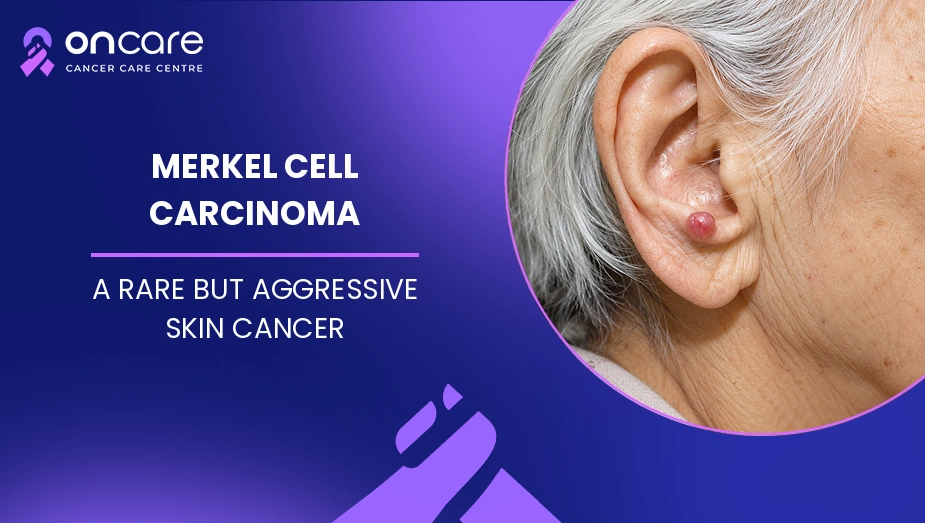
Merkel Cell Carcinoma (MCC) is a rare type of skin cancer that can grow quickly and spread to nearby lymph nodes or other parts of the body. It often appears as a firm, shiny, painless red, pink, or purple lump on sun-exposed skin. Early diagnosis is important because treatment is usually easier before the cancer spreads.
In this blog, we are talking about Merkel Cell Carcinoma, how it starts, its common signs, risk factors, diagnosis and treatment options. We will also explain why this skin cancer can be aggressive, how doctors check whether it has spread and why regular follow-up is important.
What is Merkel Cell Carcinoma?
Merkel Cell Carcinoma is a rare skin cancer that starts in Merkel cells, which are special cells found close to nerve endings in the skin. These cells help us feel light touch. When these cells grow in an uncontrolled way, Merkel Cell Carcinoma can develop.
Unlike some common skin cancers, MCC can grow quickly and has a greater chance of spreading. It most often develops on areas that get a lot of sunlight, such as the face, neck, arms and legs, but it can appear anywhere on the body.
What does Merkel Cell Carcinoma look like?
The first sign is often a new lump or bump on the skin. It is usually painless, firm and shiny. Its colour may be pink, red or purple. The lump may grow quickly over a few weeks or months and may sometimes become an open sore or bleed.
Because MCC is rare, it can look like other skin problems in the beginning. This is why a new or fast-growing skin lump should not be ignored.
Common signs to watch for
- A new firm lump on the skin
- Pink, red or purple colour
- Fast increase in size
- A lump that usually does not hurt
- Bleeding or an open sore
- Swollen lymph nodes near the lump
You can also learn about other important skin cancer symptoms and warning signs through our blog.
What causes Merkel Cell Carcinoma?
The exact cause of MCC is not always clear. Strong exposure to ultraviolet (UV) rays from sunlight is an important risk factor. A weakened immune system can also increase the chance of developing this cancer. Risk is also higher in older adults, especially people over 50. A previous history of cancer may also increase risk.
A virus called Merkel cell polyomavirus has been linked to some cases of MCC, but not every case is related to this virus. Researchers are still studying how the virus and other changes in cells may contribute to the disease.
How is Merkel Cell Carcinoma diagnosed?
Doctors first examine the skin and ask about when the lump appeared, how quickly it has changed and whether it has bled or caused other changes. A skin biopsy is usually needed to confirm whether the lump is MCC. A small sample of the suspicious area is sent to a laboratory, where it is checked under a microscope.
Doctors may also check nearby lymph nodes because MCC can spread to them. A sentinel lymph node biopsy may be used to look for cancer cells in the first lymph nodes where the cancer is likely to spread. CT, MRI, or PET scans may also be used when doctors need to check other parts of the body.
What are the stages of Merkel Cell Carcinoma?
Staging shows how far the cancer has spread. Doctors usually use the TNM system, which looks at the size and growth of the main tumour, nearby lymph nodes and spread to distant parts of the body. MCC can range from stage 0 to stage IV.
Stage | Simple meaning |
|---|---|
Stage 0 | Abnormal cells are limited to the top layer of skin |
Stage I | Small cancer, up to 2 cm, without known spread |
Stage II | Larger tumour or spread into nearby tissues |
Stage III | Cancer has spread to nearby lymph nodes or nearby areas |
Stage IV | Cancer has spread to distant parts of the body |
The exact stage can be more detailed than this table, so doctors use biopsy and scan results to decide the stage and treatment plan.
How is Merkel Cell Carcinoma treated?
Treatment depends on the stage, size and location of the tumour, whether lymph nodes are involved and the person’s overall health. More than one treatment may be used.
Surgery
Surgery is a main treatment for many people with MCC. The surgeon removes the cancer along with some nearby normal tissue. A sentinel lymph node biopsy may also be done to check whether the cancer has reached the lymph nodes.
Radiation therapy
Radiation therapy uses high-energy rays to destroy cancer cells. It may be used after surgery when there is a higher risk of the cancer coming back, or when surgery cannot be done in some situations.
Immunotherapy
For advanced or metastatic MCC, immunotherapy has become an important treatment option. Medicines such as avelumab, pembrolizumab and retifanlimab help the immune system recognise and attack cancer cells. You can read more about Types of Cancer Immunotherapy through our blog.
Chemotherapy
Chemotherapy may be used in some advanced cases, particularly when immunotherapy cannot be used, or the cancer continues to grow despite it. The choice depends on the patient’s condition and previous treatment.
Why follow-up is important
Merkel Cell Carcinoma can come back after treatment, so regular follow-up is important. Doctors may examine the skin, check nearby lymph nodes and use scans when needed. Any new or changing lump should be reported without delay.
Patients should also protect their skin from excessive UV exposure and follow the follow-up plan given by their cancer care team. Regular monitoring can help doctors identify a recurrence or other changes as early as possible.
If you want to learn more about Merkel Cell Carcinoma treatment, then you can visit the official website of the National Cancer Institute.
Consult Today
A fast-growing or unusual skin lump should always be checked by a doctor, especially when it continues to change in size or appearance. At Oncare Cancer Hospital, patients can discuss skin biopsy, staging, surgery, radiation therapy, immunotherapy and follow-up care with the specialist team based on their individual condition.
Disclaimer
This information is for educational purposes only and does not constitute medical advice, diagnosis, or treatment. Always discuss decisions about a skin lump, biopsy or any Merkel Cell Carcinoma treatment with a certified cancer healthcare provider.





Frequently Asked Questions
Yes. MCC is rare but can grow quickly and spread to lymph nodes or other parts of the body.
It often looks like a firm, shiny, painless red, pink or purple lump that grows quickly.
Early MCC may be treated successfully, but the outcome depends on the stage, spread and response to treatment.
Surgery is commonly used for local disease. Radiation and immunotherapy may also be used depending on the stage and individual condition.
Written and Verified by:
Dr. Gajendra Kumar Himanshu Exp: 10 Yr
Medical Officer
Book an Appointment
Related Blogs
MGUS: When an Abnormal Blood Protein Is Not Yet Cancer
Learn what MGUS is, its symptoms, M protein tests, the risk of multiple myeloma and why regular monitoring matters with Oncare Cancer Hospital.
Waldenström Macroglobulinaemia: A Rare Blood Cancer Explained
Learn about Waldenström Macroglobulinaemia, its symptoms, IgM, diagnosis, treatment options and when treatment is needed with Oncare Cancer Hospital.

Breast Cancer Screening for Women With Breast Implants: What Changes
Learn how breast cancer screening changes with implants, implant-displacement views and when ultrasound or MRI may be needed at Oncare Cancer Hospital.