

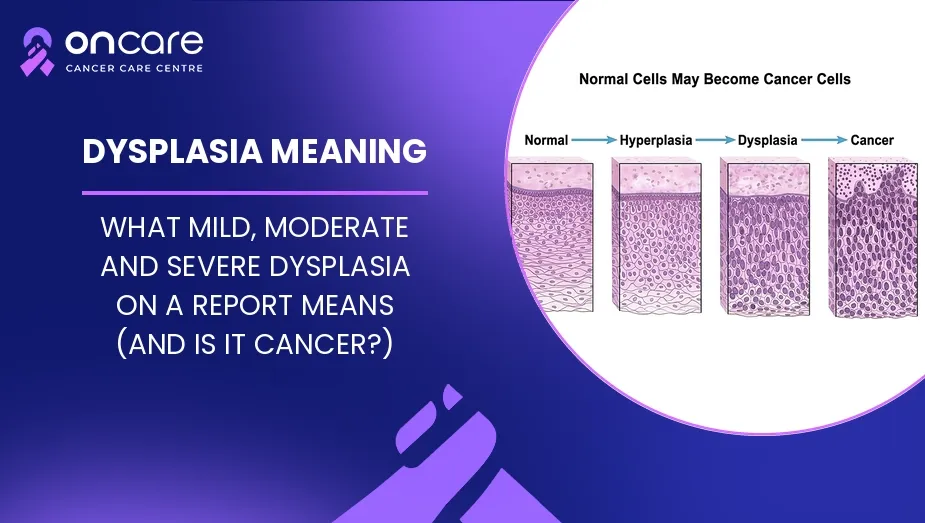
Dysplasia is an alteration in size, shape, and organization of cells in a particular tissue. If your biopsy results state mild, moderate, or severe dysplasia, then it is an indication that some cells have abnormal features compared to normal cells under a microscope. However, dysplasia is not necessarily cancer. The word is also used for conditions present from birth, such as hip dysplasia, which have nothing to do with cancer. This blog covers dysplasia found in cells on a Pap test or biopsy report.
The abnormal changes may occur in various parts of the body such as the cervix, mouth, colon, stomach, lungs, and skin. The implications of the condition vary based on the type of tissue and how severe the cellular changes are. While some of the changes may go back to normal, some dysplasia may need treatment to avoid any progression into something worse.
In this article, we will discuss dysplasia meaning, its types, cancer risk, causes, diagnosis, and treatment.
What Is Dysplasia?
Dysplasia is a condition characterized by abnormalities in the development and organization of the cells of tissues.
Under normal conditions, the growth and development of the cells take place in a controlled way through proliferation, maturation, differentiation, and replacement of old or damaged cells. In the case of dysplasia, the cells grow in abnormal shapes and sizes.
Dysplasia is considered a precancerous change: it is not cancer, but some types can turn into cancer if left untreated. The importance of dysplasia is dependent on the organ affected and the grade.
What Does Dysplasia Mean on a Biopsy Report?
If your biopsy report contains dysplasia, then it is an indication that there are some abnormalities in the cells of the tissue collected. Biopsy is a procedure that removes a small tissue sample to be examined under the microscope. The biopsy report will list out the following things:
Abnormalities: Whether there are any abnormal cell changes present.
Grade: Whether the abnormality is mild, moderate, severe or low grade or high grade.
Tissue affected: Tissue from which the abnormality is detected.
Other abnormalities: Any other abnormality, like infection or inflammation.
It is important to remember that an abnormal biopsy result does not mean you have cancer. Your doctor analyzes all of your results together.
What Are the Different Grades of Dysplasia?
The classification of dysplasia depends on how abnormally the cells look when viewed through a microscope. The tissues can be classified using mild, moderate, or severe grades, or low-grade and high-grade dysplasias.
What Is Mild Dysplasia?
Mild dysplasia means the abnormal cells are only in the lower third of the tissue lining. It is a relatively mild abnormality. Some of the milder abnormalities can revert to normal even without any form of intervention. This occurs in mild cervical dysplasia (CIN 1), where the infection from the HPV will resolve itself naturally. Monitoring is required in such instances.
What Is Moderate Dysplasia?
The dysplasia is more severe compared to mild dysplasia and there are more observable changes in the cells. The abnormal cells reach up to about two-thirds of the tissue lining. When it occurs in cervical tissues, it is usually CIN 2. The treatment may vary based on age, history of the patient, and examination results.
What Is Severe Dysplasia?
Severe dysplasia includes abnormal appearance and arrangement of cells. This is regarded as high-grade dysplasia. The abnormal cells reach more than two-thirds of the lining, or its full thickness. In the cervix, this is called CIN 3. CIN 3 does not necessarily mean invasive cancer, but there is a possibility of its progression.
How Do the Three Grades Compare?
Feature | Mild | Moderate | Severe |
|---|---|---|---|
Cellular changes | Slight | Noticeable | Significant |
General grade | Low-grade | Intermediate or high-grade, depending on tissue | High-grade |
Where abnormal cells are | Lower one-third of the cervical lining | Up to two-thirds of the cervical lining | More than two-thirds of the cervical lining; may involve full thickness |
Cervix report term | CIN 1 (LSIL) | CIN 2 (HSIL) | CIN 3 (HSIL) |
Management | Often monitoring | Monitoring or treatment | Usually treatment |
Dysplasia Terms on Your Pap or Biopsy Report
If your pap test or cervical biopsy result includes any of the following medical terms, understanding what they mean will assist you when discussing your results with your doctor.
ASC-US (Atypical Squamous Cells of Uncertain Significance): Squamous cells are slightly abnormal in appearance, but it is not known what causes this alteration.
LSIL (Low Grade Squamous Intraepithelial Lesion): This is a mild condition wherein there are abnormalities in the cervix cells and is usually caused by HPV.
HSIL (High Grade Squamous Intraepithelial Lesion): Reflects greater abnormal changes in the cells of the cervix and is associated with CIN 2 or CIN 3.
CIN 1 (Cervical Intraepithelial Neoplasia 1): Mild cervical cell changes involving about one-third of the thickness of the cervical epithelium.
CIN 2 (Cervical Intraepithelial Neoplasia 2): Moderate cervical cellular changes that occur in up to two-thirds of the cervical tissue.
CIN 3 (Cervical Intraepithelial Neoplasia 3): It refers to serious abnormality of cells on the cervix that is confined to at least two-thirds or the entire cervical layer, without invasion.
Carcinoma in situ: This is where the cells cover the entire epithelial layer and they have not yet invaded the underlying tissues. It refers to CIN 3 when used in reference to the cervix.
Note: ASCUS, LSIL, and HSIL are terms usually found in Pap smear (cytology) reports while CIN I, CIN II, and CIN III are usually seen in biopsy (histology) reports. The finding of an abnormal Pap smear doesn't always mean that one has cancer.
Is Dysplasia Cancer or a Precancerous Condition?
Dysplasia does not mean cancer. However, some forms can potentially evolve into cancers. These differences include:
Dysplasia: Abnormal cells without invasion of neighboring tissues.
Carcinoma in situ: Very abnormal cells that stay limited to the tissue layer from which they originated.
Invasive cancer: Abnormal cells invade neighboring tissues and may metastasize.
Severe dysplasia and carcinoma in situ may be interchangeable in some medical definitions. The interpretation of these terms depends on the organ affected.
Where Can Dysplasia Develop in the Body?
Dysplasia occurs in various body parts and tissues. The causes and health implications of the disorder differ depending on its location.
Cervix: Cervical dysplasia refers to abnormalities in the cells of the cervix and occurs due to persistent high-risk HPV infection.
Food pipe (oesophagus): Dysplasia in Barrett's oesophagus, linked to long-term acid reflux.
Mouth: Oral dysplasia occurs in mouth lining and manifests in persistent white or red patches.
Colon: Colonic dysplasia refers to abnormalities in colon cells and can be detected through colonoscopy.
Stomach: Gastric dysplasia occurs in stomach cells and can coexist with persistent inflammation.
Lungs: Bronchial dysplasia refers to abnormalities in cells of the airways and is related to tobacco use.
Skin: Skin cell abnormalities occur due to persistent exposure to ultraviolet radiation. One example is actinic keratosis, a precancerous skin condition that causes rough, scaly patches and may develop into squamous cell skin cancer if left untreated.
What Causes Dysplasia?
Dysplasia occurs because of various changes in the normal cell growth and development process. Some of the most common causes include:
1. HPV Infection
Long-term infection with high-risk HPV types is the main cause of cervical dysplasia.
2. Tobacco Consumption
Smoking and chewing of tobacco introduces harmful substances into the body, which can harm cells. Areca nut, gutka, and paan containing tobacco or areca nut are also associated with an increased risk of oral cell abnormalities and mouth dysplasia.
3. Chronic Inflammation
Chronic inflammation can also be detrimental to tissue regeneration. People with ulcerative colitis have a chance of developing colonic dysplasia.
4. Chronic Infection
Chronic infections like H. Pylori infection lead to chronic inflammation of the stomach and hence an increased risk of gastric dysplasia.
5. Sun Exposure
Prolonged exposure to ultraviolet radiation can affect the DNA of skin cells, causing abnormal cellular changes.
6. Genetic Changes
Changes to the genetic material related to cell growth and division can affect normal cell development.
7. Long-term Acid Reflux
Persistent gastro-esophageal reflux disease causes injury to the lining of the esophagus resulting in Barrett's esophagus. It is a condition where the lining of the esophagus undergoes certain changes and predisposes to the development of dysplasia and adenocarcinoma.
Can Dysplasia Be Prevented?
However, not all cases of dysplasia are preventable; however, there are ways through which an individual can prevent themselves from being affected by specific kinds of dysplasia.
HPV vaccination: Getting HPV vaccines can prevent infection from certain types of high-risk HPV which cause precancerous lesions of the cervix.
Get regular Pap smear and HPV testing: They assist in the identification of abnormal cells in the cervix and any infection caused by HPV.
Tobacco and areca nut should be avoided: Stopping the use of cigarettes and not consuming tobacco or gutka can lower the chance of having abnormal cells in the mouth.
H. pylori infection and acid reflux: Suitable treatment may aid in dealing with the stomach and oesophagus inflammation caused by gastric and oesophageal changes.
Prevent damage from the sun: Apply sunscreen, wear protective clothing, and limit exposure to UV rays in order to prevent skin damage.
What Symptoms Can Dysplasia Cause?
Dysplasia is usually asymptomatic and can be detected by routine testing or biopsy. In case of presence of any symptoms, they vary according to the involved organ.
Type | Possible symptoms |
|---|---|
Cervical | Usually no symptoms |
Oral | Persistent white or red patches inside the mouth |
Colonic | Often no specific symptoms |
Gastric | Usually no specific symptoms |
Bronchial | May have no specific symptoms |
Skin | Rough, scaly, or discoloured patches |
These signs can have other causes. Only a biopsy can confirm dysplasia.
How Is Dysplasia Diagnosed?
Physicians conduct screening tests and examination of tissues to detect abnormal cellular changes. Diagnostic procedures that are common include:
1. Screening Tests
Pap test: This test detects abnormal cervical cells.
HPV test: The HPV test detects high-risk human papillomavirus infection.
Colonoscopy: This procedure examines the colon to detect unusual growths or abnormalities.
2. Endoscopy
Endoscopy is used by doctors to look inside the body through a long flexible tube that contains a camera. Depending on the part of the body that is affected, they may recommend gastroscopy, bronchoscopy, and colonoscopy.
Colposcopy: A procedure that uses a magnifying instrument called a colposcope to examine the cervix closely from outside the body.
3. Biopsy
Biopsy involves taking a tiny piece of tissue for microscopical examination. It enables dysplasia detection and grading.
4. Histopathological Examination
The pathologist uses histopathology to differentiate between normal cells, dysplasia, carcinoma in situ, and invasive carcinoma.
Can Dysplasia Turn Into Cancer?
Some forms of dysplasia can lead to cancer, although this does not always occur. This possibility varies according to the grade, organ in question, etiology, and duration of the disease.
Mild dysplasia: Generally considered to have a relatively low risk of developing into cancer and is likely to go away by itself. For instance, about 60% of CIN 1 lesions tend to spontaneously disappear in 2 years' time.
Moderate Dysplasia: It may persist in the same level, regress, or advance. Follow up is essential in addition to treatment in certain instances.
Severe Dysplasia: Has a higher chance of turning into cancer and usually needs treatment soon.
For example, CIN 3 is a very serious precancerous lesion involving the cervix. In past studies involving untreated cases of CIN 3, roughly one-third of cases developed into invasive cervical cancer after several years. Nevertheless, this does not imply that CIN 3 is an invasive cervical cancer already.
What Are the Treatment Options for Dysplasia?
The treatment varies according to the grading, location, and progression potential. In some cases, there is a need for observation, but in other cases there will be a need to conduct surgical procedures to remove the abnormal tissue.
1. Active Surveillance
Sometimes doctors will advise screening or performing biopsies periodically for certain low-grade lesions to see if the condition improves or gets worse.
2. Treating the Underlying Condition
In case there is an infection or chronic inflammation causing dysplasia, doctors might treat the underlying problem, but that does not guarantee the reversal of cellular changes.
3. Removal of Dysplasia
There might be various procedures to remove dysplasia tissue depending on the organ where dysplasia occurs, and they include LEEP or cone biopsy (cervix), and endoscopic removal (stomach, food pipe and colon).
4. Ablation Techniques
Ablation refers to the destruction of abnormal cells through techniques like cryotherapy, laser therapy, and thermal ablation. These treatment approaches are applicable to certain conditions only.
5. Periodic Monitoring
Follow-up screening, endoscopy, or biopsy might become a requirement despite treatment because of ongoing or recurring anomalies.
When Should You Consult a Doctor?
See a medical professional if your screening test or biopsy shows signs of dysplasia, regardless of whether you have any symptoms. It is especially critical to consult a healthcare provider if:
- Your results show that you have moderate or severe dysplasia.
- You have been found to have high-grade lesions.
- You have seen persistent white or red spots in your mouth.
- You experience unexplained bleeding and/or changes in your bowel movements.
- Your healthcare provider suggests further testing or removal of the diseased tissue.
Early follow-up helps catch any change before it becomes cancer.
Consult Today
A report that says "dysplasia" can be worrying and hard to understand. A specialist can explain your grade, your cancer risk and whether you need treatment.
If your report indicates abnormal conditions, seek medical assistance from an oncologist at the Oncare Cancer Hospital. regarding diagnosis, tests, and appropriate treatments.
Disclaimer
This article has been prepared for educational purposes only and should not be taken as a substitute for professional medical advice, diagnosis, or treatment. Dysplasia staging and treatment are different depending on which organ has been affected and personal medical results. Please consult a physician for more information about your case.
Frequently Asked Questions
Is dysplasia the same as cancer?
No. Dysplasia is the description of abnormal cell development and is not invasive cancer. Some specific forms can become cancer over time.
Can mild dysplasia disappear on its own?
Yes. Some mild cases of dysplasia, especially cervical CIN 1, can clear up without intervention. Follow-up appointments are nonetheless necessary.
Will all cases of severe dysplasia become cancer?
No. Not all severe dysplasia turns into cancer, but the risk is higher, so it is usually treated..
Does dysplasia require surgery?
No, not necessarily. Some milder cases will only need monitoring, but moderate or severe cases may need a short procedure such as LEEP, often done as a day-care procedure.
Is moderate dysplasia serious?
The term moderate dysplasia means that there are some abnormalities in cells which can be seen better than those in cells in case of mild dysplasia. However, moderate dysplasia does not necessarily mean cancer, but it still needs to be examined.
What is high-grade dysplasia?
High-grade dysplasia is defined as a major abnormality in cells which have more potential to turn cancerous than low-grade abnormal cells. In case of cervical cells, high-grade dysplasia usually consists of CIN 2 and CIN 3.
Can dysplasia come back after treatment?
Yes, because dysplasia can recur despite having undergone treatment. This is especially true if there still remain risk factors which could lead to recurrence of abnormal cells.
Is cervical dysplasia contagious?
No. Cervical dysplasia, by itself, is non-infectious and cannot be transmitted between people. But an ongoing infection with high-risk HPV (human papillomavirus), which leads to cervical dysplasia, may be sexually transmitted.