Table of Contents
Breast Cancer Risk Assessment: How Tools Like the Gail Model Estimate Your Risk

By Dr. Gajendra Kumar Himanshu


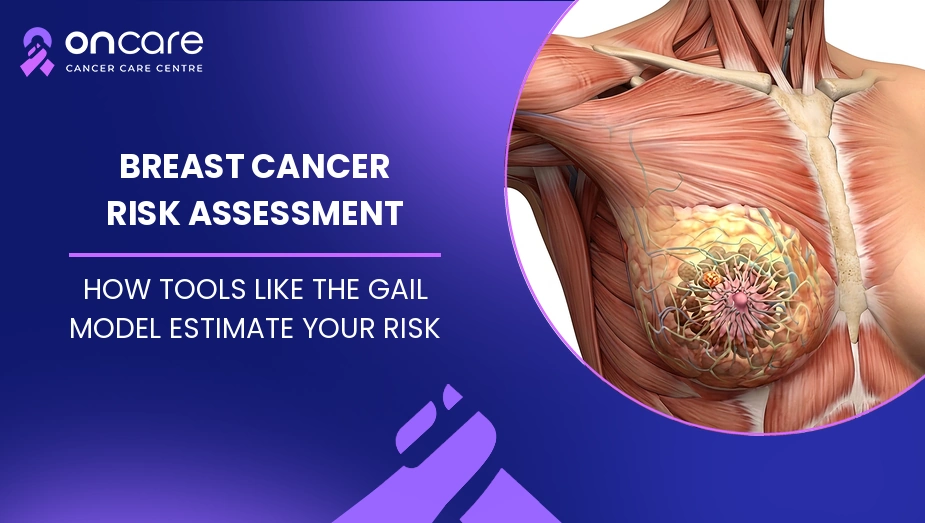
Breast cancer risk assessment tools, such as the Gail Model, help estimate a woman’s chance of developing breast cancer over a certain period. They use information such as age, family history, reproductive history, and previous breast biopsies to calculate an estimated risk. These tools cannot predict with certainty who will develop breast cancer, but they can help doctors understand a woman’s risk and plan suitable screening or preventive care.
Understanding your breast cancer risk is an important step towards better breast health. In this blog, we will explain how breast cancer risk assessment works, what the Gail Model measures, which factors affect your results, and when you may need a more detailed assessment.
What Is Breast Cancer Risk Assessment?
Breast cancer risk assessment is a way to assist you in evaluating your chances of getting breast cancer in the future. Doctors look at a variety of characteristics, including age, medical history, family history and hormonal or reproductive history to evaluate a person’s risk.
Some women are at higher risk because they have inherited gene alterations or have a strong family history of breast cancer. Others may have a medium risk depending on the information available. But just because you are at higher risk doesn’t mean you are going to get cancer, and just because you are at lesser risk doesn’t mean you are totally safe.
You can learn more about Breast Cancer Signs to understand which factors may affect your breast health.
What Is the Gail Model?
The Gail Model is a breast cancer risk assessment tool that evaluates a woman’s chances of acquiring invasive breast cancer during the next five years and up to age 90. It is also called the Breast Cancer Risk Assessment Tool (BCRAT).
The model was constructed based on data from large groups of women. It compares a woman’s personal information to patterns from similar populations to assess her risk.
Doctors may use the Gail Model to identify women for whom breast cancer prevention and screening discussions would be more appropriate. But the outcome is an estimate, not a diagnosis or a guarantee of what will happen.
How Does the Gail Model Estimate Breast Cancer Risk?
The Gail Model uses several pieces of information to calculate an estimated risk. The answers help the tool compare an individual with other women who have similar characteristics.
1. Age
Age is an important factor in breast cancer risk. The chance of developing breast cancer generally increases as women grow older. The Gail Model uses age as part of its calculation.
2. Family History of Breast Cancer
The model asks about breast cancer in close female relatives, such as a mother, sister, or daughter. A history of breast cancer in these relatives can affect the estimated risk.
However, the Gail Model does not capture every family history pattern. For example, it does not fully account for the number of affected relatives, their ages at diagnosis, or the complete family history on both sides.
3. Reproductive History
Certain reproductive factors can affect breast cancer risk. The model considers the age when a woman first had her menstrual period and the age when she first gave birth to a child.
These details help the tool estimate risk based on patterns observed in research.
4. Previous Breast Biopsies
The model also considers whether a woman has had a breast biopsy in the past and whether the biopsy showed atypical hyperplasia, a type of abnormal cell growth associated with a higher risk of breast cancer.
Together, these details help the model estimate a woman’s five-year and longer-term risk.
What Do the Gail Model Results Mean?
The Gail Model usually provides two main estimates: five-year risk and lifetime risk.
- Five-year risk: The estimated chance of developing invasive breast cancer during the next five years.
- Lifetime risk: The estimated chance of developing invasive breast cancer over the longer period covered by the tool, up to age 90.
For example, a five-year risk of 2% means that, among 100 women with the same estimated risk, about two would be expected to develop invasive breast cancer over five years. It does not identify which women will develop it.
A doctor can explain whether the result is considered higher than average and whether further assessment or preventive steps may be helpful. The number should always be understood in the context of a woman’s overall health and medical history.
Gail Model vs Other Breast Cancer Risk Assessment Tools
The Gail Model is useful, but it is not the only tool available. Different tools consider different risk factors, so the most suitable option depends on a woman's medical and family history.
Feature | Gail Model | Other Risk Assessment Tools |
|---|---|---|
Main purpose | Estimates five-year and longer-term breast cancer risk | Estimates risk using different combinations of personal, family, and genetic factors |
Information used | Age, reproductive history, close relatives, and biopsy history | May include detailed family history, breast density, or genetic information |
Best use | Assessing risk in women for whom the model is suitable | Assessing women whose risk needs a more detailed evaluation |
Main limitation | May miss inherited and complex family risk patterns | Accuracy depends on the tool and the information provided |
Other tools, such as the Tyrer-Cuzick model and the BRCAPRO model, may be more appropriate for some women, particularly those with a strong family history or possible inherited risk. A healthcare professional can help select the right tool.
Who Should Consider Breast Cancer Risk Assessment?
Risk assessment may be helpful for women who want to understand their personal breast cancer risk, especially if they have certain risk factors.
You may benefit from discussing an assessment with a doctor if you:
- Have a mother, sister, or daughter who has had breast cancer.
- Have a history of certain abnormal breast biopsy results.
- Have a known inherited gene change linked to breast cancer.
- Have questions about when to begin screening or whether you need additional tests.
Women with a strong family history or a known BRCA1 or BRCA2 gene change may need a different assessment from the Gail Model. Doctors may recommend genetic counselling or testing when appropriate. Read more about BRCA1 and BRCA2 gene testing to understand how inherited gene changes are assessed.
What Are the Limitations of the Gail Model?
Although the Gail Model can help assess risk, it has some important limitations.
First, it cannot determine with precision whether a woman will develop breast cancer. It draws on patterns seen in groups of people to provide estimates, so individual results will vary.
Second, the model does not completely incorporate inherited genetic risk or comprehensive family history. It may not be suitable for women who have already been diagnosed with breast cancer, ductal carcinoma in situ (DCIS) or lobular carcinoma in situ (LCIS).
Third, it may be less accurate in some populations than others. The model was created and validated in specific populations, and the estimates may not be equally applicable to all women, including women in India.
For these reasons, doctors do not rely on the score alone and use it together with other relevant information.
Can Breast Cancer Risk Assessment Help With Screening?
Yes. Risk assessment can help doctors discuss an appropriate breast cancer screening plan. Depending on a woman’s age, medical history, and estimated risk, they may recommend routine mammography, additional imaging, genetic counselling, or other preventive measures.
However, a risk score does not replace screening. Even women with a low estimated risk may develop breast cancer, so it is important to follow medical advice about screening.
If you want to understand the available screening options, read our guide to breast cancer screening tests. If you notice a new breast lump, nipple discharge, skin changes, or another unusual change, consult a doctor rather than waiting for a risk assessment.
If you want to learn more about breast cancer, then you can visit the official website of the National Cancer Institute.
Consult Today
Understanding your breast cancer risk can help you make informed decisions about screening and preventive care. However, the right approach depends on your personal and family history, age, and other health factors.
At Oncare Cancer Hospital, you can consult a cancer care specialist to discuss your concerns, understand your risk factors, and learn which screening or assessment options may be suitable for you. Do not wait for symptoms or rely only on an online risk calculator. Book a consultation to discuss the next steps for your breast health.
Disclaimer
This blog is for informational purposes only and is not a substitute for professional medical advice. Consult a qualified doctor for personalised breast cancer risk assessment and screening guidance.





Frequently Asked Questions
The Gail Model can estimate breast cancer risk for suitable groups, but it cannot predict an individual’s future with certainty. Its accuracy varies depending on the population and medical history.
No. It estimates the chance of developing breast cancer. Tests such as mammography and, when needed, a biopsy help doctors investigate or diagnose the disease.
No. A low score means the estimated risk is lower according to the model. Breast cancer can still occur, so follow the screening advice given by your doctor.
Women with a strong family history, known inherited gene changes, or a previous breast cancer diagnosis may need a different risk assessment. A doctor can recommend a more suitable approach.
Written and Verified by:
Dr. Gajendra Kumar Himanshu Exp: 10 Yr
Medical Officer
Book an Appointment
Related Blogs
How to Check for Breast Cancer at Home: Step-by-Step Guide
Learn how to do a breast self-exam at home for early detection of cancer. A simple, monthly routine to spot changes and take action for better health.

Can Early-Stage Breast Cancer Be Cured? Here’s What Experts Say
Discover more about early-stage breast cancer and whether these breast cancer is curable and types of factors affecting the cure/long-term survival of these cancers!
Breast Cancer Symptoms: How to Recognize the Warning Signs Early
Learn common breast cancer symptoms, including lumps, nipple and skin changes, discharge, and pain. Know when to see a doctor. Oncare Cancer Hospital's advice.