Table of Contents
Salivary Gland Tumors: Types, Warning Signs, and Treatment Options

By Dr. Gajendra Kumar Himanshu


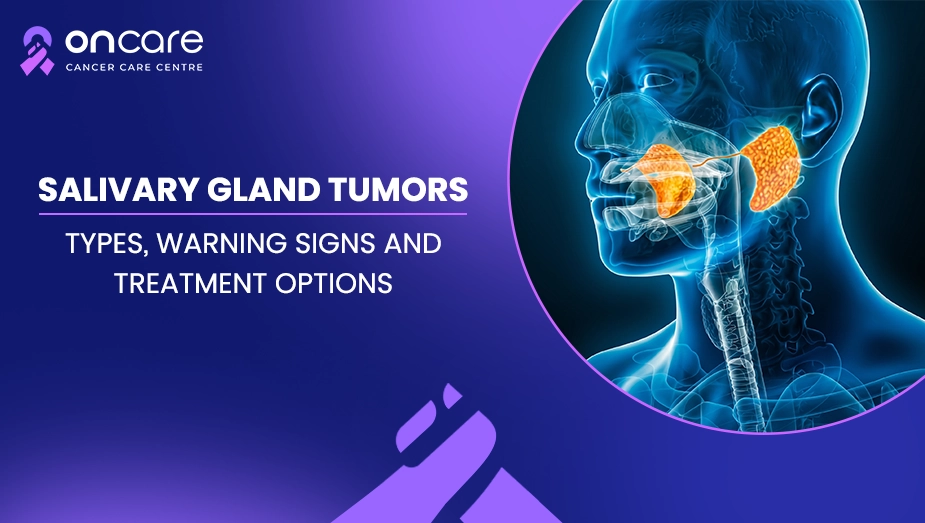
Salivary gland tumors are abnormal growths in the salivary glands. The salivary glands produce saliva, which helps you chew, swallow, and digest food. Tumors, both benign (non-cancerous) and malignant (cancerous), can develop in any of the major or minor salivary glands situated around the mouth, jaw, and throat. Many salivary gland tumors develop slowly and may initially present as a painless lump around the jaw, face, or neck.
Not every lump is cancer, but any lump that doesn't go away, facial weakness, discomfort, or other strange symptoms should be checked out by a health care specialist. Early diagnosis and proper treatment can help patients understand their condition and make informed decisions about their care. Treatment options will depend on the type of tumor, where it is located, your overall health, and your doctor's recommendations.
In this blog, we are going to talk about the various types of salivary gland tumors, the common warning signs, how doctors diagnose them, and the treatment options that might be offered.
What Are Salivary Gland Tumors?
Saliva is produced by the salivary glands, and it moistens the mouth and aids in digestion. The major salivary glands are:
- Parotid gland
- Submandibular glands
- Sublingual gland
There are also many tiny salivary glands scattered around the mouth and throat. A tumor arises when cells begin to grow abnormally in these glands.
Salivary Gland Tumor Types
Salivary gland tumors can be benign or malignant.
Non-Cancer (Benign) Tumors
Benign tumors do not metastasize to other regions of the body. Common benign tumors include:
- Pleomorphic Adenoma
- Warthin’s tumor
Benign tumors are not cancerous; however, your doctor may still advise therapy depending on the size, location, and symptoms of the tumor.
Cancerous (Malignant) Tumors
Malignant tumors can infect adjacent tissues and spread to other regions of the body. Examples may include:
- Mucoepidermoid Carcinoma
- Adenoid cystic carcinoma
- Acinic Cell Carcinoma
- Carcinoma of the salivary duct
How these malignancies behave can differ from person to person.
Warning Signs You Shouldn’t Ignore
Some salivary gland cancers grow slowly and may not cause symptoms right away. Possible warning indicators can include:
- A bump on the jaw, neck, cheek, or in the mouth
- Swelling for a long time
- Facial or jaw pain
- Swallowing problems
- Numbness in one portion of the face
- Weakness in facial muscles
- Difficulty in opening the mouth widely
Having these symptoms does not signify that you have cancer, but any symptoms that do not go away should be checked by a health care professional.
A Practical Handbook of Common Symptoms
Sign | Reasons to Consider Assessment |
|---|---|
Lump in the jaw or neck | May be a growth of a salivary gland |
Swelling of the face | Further investigation may be required |
Facial paralysis | Could damage the nerves near the gland |
Trouble swallowing | Requires medical attention |
Continuous pain | May need a medical assessment |
Who Is at Greater Risk?
The specific cause of many salivary gland cancers is not known. But certain variables may raise the risk:
- Advanced age
- History of previous irradiation
- Some work exposures
- Personal medical history
- Family history in some instances
Risk factors do not mean that a person will get a tumor. They only help clinicians get a sense of the big-picture risk.
How Salivary Gland Tumors Are Diagnosed
Doctors may order several tests if they suspect a salivary gland tumor.
On Physical Examination
Usually, doctors start by looking at the affected area and analyzing symptoms.
Tests and Imaging
Imaging investigations may include:
- Ultrasound
- CT scan
- MRI
These tests assist in finding out how big the tumour is and where it is.
Biopsy
Removal of a sample of tissue for evaluation in the laboratory. This helps doctors decide:
- If the tumor is benign or cancerous
- The precise tumor type
- Potential treatment options
Salivary Gland Tumor Treatment
Treatment varies depending on the type of tumor, location, stage, overall health, and medical guidance.
Surgical Therapy
Surgery is often used to remove the tumor, where appropriate. The amount of surgery depends on:
- Size of tumor
- Location of the tumor
- Involvement of neighboring structures
Surgical outcomes are not assured, and treatment should always be individualised.
Radiation Therapy
In several cases, radiation therapy may be recommended:
- Postoperative in selected cases
- For some malignant tumors
- To help manage illness, if applicable
Drug Treatments
Some patients may need:
- Chemotherapy
- Targeted therapies
- Other systemic therapies
The choice depends on the tumor’s features and the treatment strategy created by the health care team.
The Value of Follow-Up Care
Follow-up appointments are important so that doctors can assess healing and long-term health. These visits can include:
- Physical exams
- Tests to examine your insides
- Symptoms review
- Monitoring treatment
Regular follow-up enables healthcare staff to identify issues early and modify care as appropriate.
Reliable Sources for More Information
Reliable information helps patients and families to better understand salivary gland cancers and the treatment options.
For information based on scientific evidence regarding diagnosing and treating cancer, see the National Cancer Institute for reliable, patient-friendly education materials for patients and caregivers.
Looking Forward With Confidence
While many people successfully go through treatment and recovery with the help of knowledgeable healthcare professionals, a diagnosis of a salivary gland tumor can raise many questions.
Every case is unique. The decision concerning therapy depends on your risk level, family history, the findings of genetic testing if appropriate, your overall health, the features of the tumor, and your doctor’s advice.
Understanding your diagnosis and communicating openly with your health care provider can help you go forward with confidence.
Consult Today
Salivary gland tumors are abnormal growths of cells in the glands that produce saliva. They can be benign (without cancer) or malignant (cancer). Common warning symptoms include swelling that never goes away, lumps around the jaw or neck, weakness in the face, pain, and difficulty swallowing. Early medical evaluation can determine the reason and direct suitable treatment. Depending on your situation, you may have surgery, radiation therapy, chemotherapy, targeted therapy, or a combination of treatments.
Treatment selections should be based on personal risk, family history, genetic testing results, overall health, and the recommendations of the clinician. Oncare Cancer Hospital is a name to trust for expert guidance, complete cancer care, and compassionate patient support during diagnosis, treatment, recovery, and survivorship.





Frequently Asked Questions
They are abnormal growths in the glands that create saliva.
No. Some tumors are benign (not cancerous); others are malignant (cancerous).
A typical indication is a lump or swelling that doesn't go away near the jaw, neck, cheek, or mouth.
Depending on the individual instance, treatment may involve surgery, radiation therapy, chemotherapy, targeted therapy, or other treatments.
Written and Verified by:
Dr. Gajendra Kumar Himanshu Exp: 10 Yr
Medical Officer
Book an Appointment
Related Blogs

Neuroendocrine Tumors (NETs): Why They're Often Misdiagnosed
Learn about Neuroendocrine Tumors (NETs), their symptoms, diagnosis, treatment options, and expert cancer care support at Oncare Cancer Hospital.

Adrenal Gland Tumors: Benign vs Malignant and What to Do Next
Learn about adrenal gland tumors, symptoms, diagnosis, benign vs malignant types, and treatment options at Oncare Cancer Hospital with expert cancer care support.

Is Tumor Curable in Early Stages? Key Insights
Learn if tumors can be cured in early stages and what treatment options. Get expert diagnosis and care support at Oncare Cancer Hospital for better outcomes.
Breast Lumps: Understanding Fibroids and Tumors
Learn about breast lumps fibroids and tumors, their causes, symptoms, and when to see a doctor. Get expert diagnosis and care at Oncare Cancer Hospital.